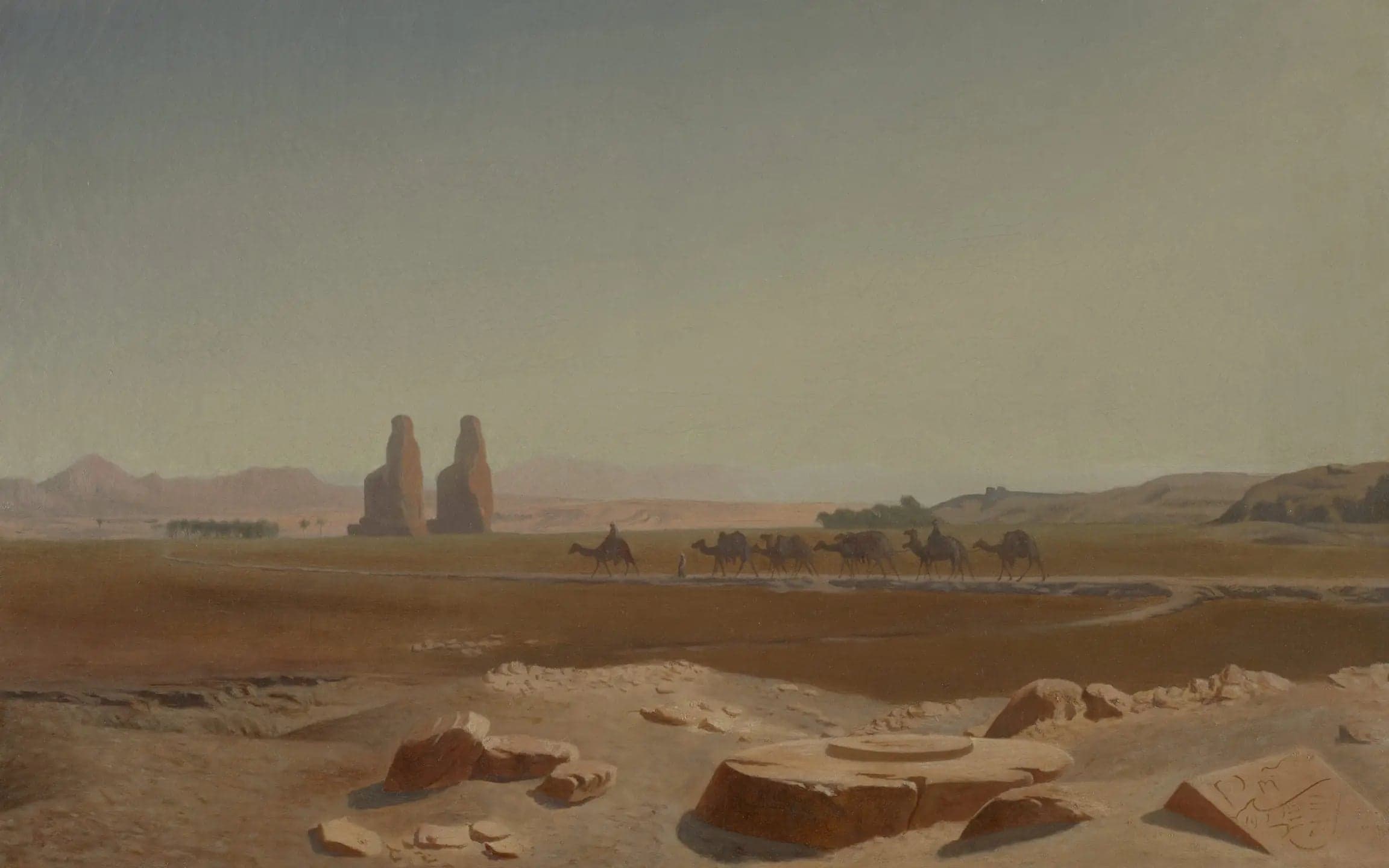
Caravan passing near the Colossi of Memnon. Thebes - Jean
- Original dimensions
- 62 x 40 cm
- Museum
- Cantonal Museum of Fine Arts of Lausanne
- Year
- 1856
Scene depicted
This magnificent painting depicts a scene brimming with humanity, where a caravan of travelers crosses the majestic plain of Thebes, near the Colossi of Memnon. These titanic statues, remnants of an ancient grandeur, seem to guard the geheimnis of Egyptian history. The golden light of the setting sun reflects on every grain of sand while the silhouettes of camels and travelers add a captivating dynamic to the landscape, thus revealing a rich and evocative narrative embedded in the canvas .
Historical context
Created in 1856, the painting "Caravan Passing Near the Colossi of Memnon. Thebes" reflects the fascination of its time for exoticism and antiquity. An emblematic work of the academic movement, it instantly transports you to the heart of ancient Egypt, where the stone giants, witnesses of centuries past, stand majestically. Currently exhibited at the Cantonal Museum of Fine Arts of Lausanne , this canvas of 62 x 40 cm evokes the breath of a bygone era, still alive in the vibrant colors of this composition .
Place in the artist's career
Positioned at the heart of Gérôme's career, "Caravan Passing Near the Colossi of Memnon" represents a meeting point between his realistic style and his penchant for the sublime. Alongside "The Dance of the Almeh" and "The Pharaoh," this painting represents a period of maturity, where the artist brilliantly exploits the nuances of light and detail, paying homage to history while inserting his own gaze into the vast landscape of contemporary art.
Anecdote
Jean-Léon Gérôme , known for his love of detail and keen sense of observation, once stated: "Every masterpiece is a thought brought to light, a whisper of the soul captured on canvas ." It is precisely in this interplay between shadows and light that he found inspiration for this painting , slowly shaped over the course of his travels in the East. The aroma of warm sand mixed with the fresh air of the Nile Valley breathed new life into this canvas .