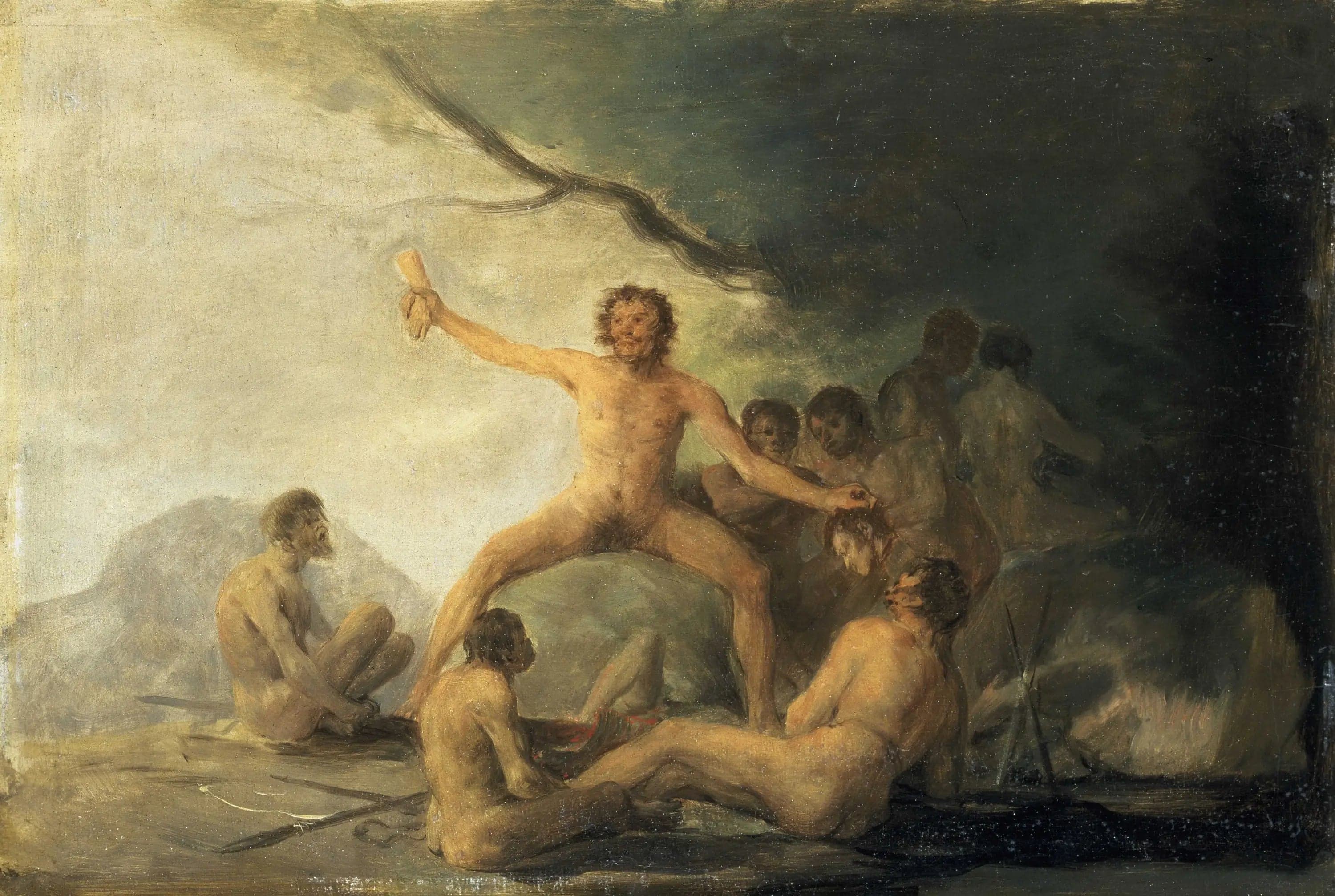
Cannibals Contemplating Human Remains
- Original dimensions
- 45 x 31 cm
- Museum
- Museum of Fine Arts and Archaeology of Besançon
- Year
- 1800
Scene depicted
This canvas depicts a poignant scene where cannibals, a disturbing silhouette of human cruelty, gaze with morbid fascination at human remains; a powerful metaphor for the consequences of war and despair. The atmosphere is imbued with a palpable tension, that of a world where the limits of humanity are redefined.
Historical context
Created in 1800, at the turn of the 18th and 19th centuries, this painting illustrates the tumultuous context of post-Napoleonic Spain. Francisco de Goya , an iconic figure of Romanticism , starts from a blank canvas to evoke the horrors of his time. Today, this canvas is located in the Museum of Fine Arts and Archaeology of Besançon, where its striking presence leaves no one indifferent.
Place in the artist's career
Cannibals Contemplating Human Remains stands as one of Goya's most significant paintings , revealing his period of maturity. By paralleling it with The Colossus and The Disasters of War, one perceives a profound emotional evolution in his work, oscillating between raw realism and intense expressionism .
Anecdote
“The human soul is stronger than any barbarity,” Goya might have said, inspired one autumn morning by the remnants of a war. In that fleeting moment, he would have discerned the haunting vision that would translate years later into this pictorial work . The strength of the painting lies in its ability to capture this moment of acute introspection.