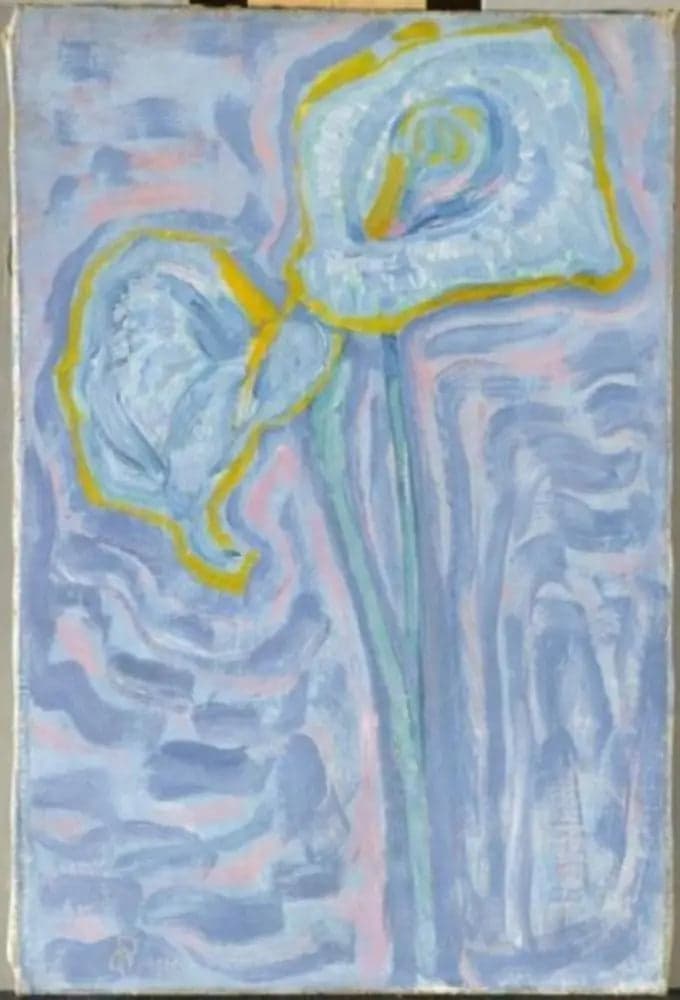
Calla Lily
- Original dimensions
- 33.5 x 50 cm
- Museum
- The Hague Museum of Art
- Year
- 1910
Scene depicted
The painting “Lys d'arum - Piet Mondrian ” will captivate your gaze with its delicate lines and elegant composition. It is an ode to floral beauty where each element is skillfully arranged to tell the harmony of life. The lily, a symbol of purity and renewal, stands majestically, embodying Mondrian's respect for nature and his desire to represent it from a new angle, far from simple figurative representation.
Historical context
Year: 1910 |BRK| Museum: The Hague Museum of Art |BRK| Dimensions: 33.5 x 50 cm
Place in the artist's career
Inserted in the midst of a stylistic transition period, this painting marks a crucial turning point in Mondrian's career, once strictly figurative, as he begins to better master abstract forms. Alongside other paintings such as “Composition with Red, Yellow, and Blue” and “Broadway Boogie Woogie,” “Lys d’arum” clearly demonstrates the shift towards striking geometric abstraction, both technologically and emotionally.
Anecdote
“Beauty is in order, harmony, and simplicity,” Mondrian might have said on a sunny morning of a Dutch spring, as he contemplated a calla lily, finding inspiration to create this masterpiece . The purified forms of nature pushed him to rise towards more abstract artistic expressions, connecting his inner essence to the magnificence of the outside world, finely transcribed in the painting .