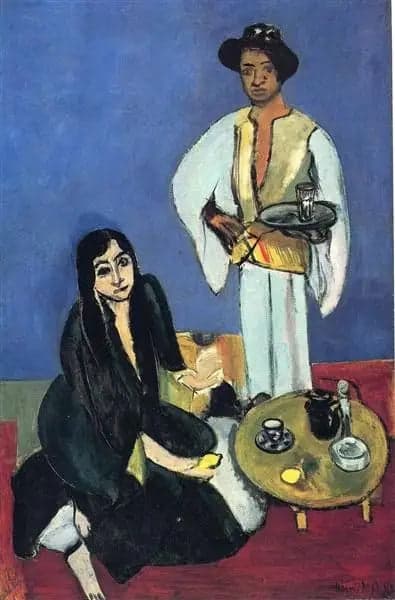
Café
- Original dimensions
- 65.4 x 100.6 cm
- Museum
- Detroit Institute of Arts
- Year
- 1916
Scene depicted
In the canvas "Café," Matisse captures the very essence of Parisian life. A set table, filled with joyful colors, evokes a suspended moment where friends and strangers gather around a coffee. The play of light and shadow enhances the shapes of the objects, transforming this ordinary scene into a canvas full of human warmth and conviviality.
Historical context
Created in 1916, during a period of intense creativity, the painting "Café" is part of the fauvist movement that was developing at the time, known for its bold colors and liberated forms. At that time, Henri Matisse illuminated the Paris neighborhood with his pictorial innovations. Today, this canvas emblematic resides at the Detroit Institute of Arts , a place of reflection for art lovers. Its dimensions, 65.4 x 100.6 cm, make it a large-scale work, magnifying the space that hosts it.
Place in the artist's career
This painting is at the very heart of Matisse's stylistic peak, revealing his exploration of color and formal freedom. Alongside his emblematic works like "The Dance" and "The Joy of Life," "Café" testifies to an evolution towards enriched abstraction and a personal pictorial language, marking a turning point in his career.
Anecdote
"In every café, there exists a world of colors and souls," Matisse is said to have remarked, recalling one of his visits to a Parisian café bathed in morning light. This vibrant and emotion-laden atmosphere permeates the composition of his masterpiece , resonating with the murmur of conversations and the scent of croissants just out of the oven.