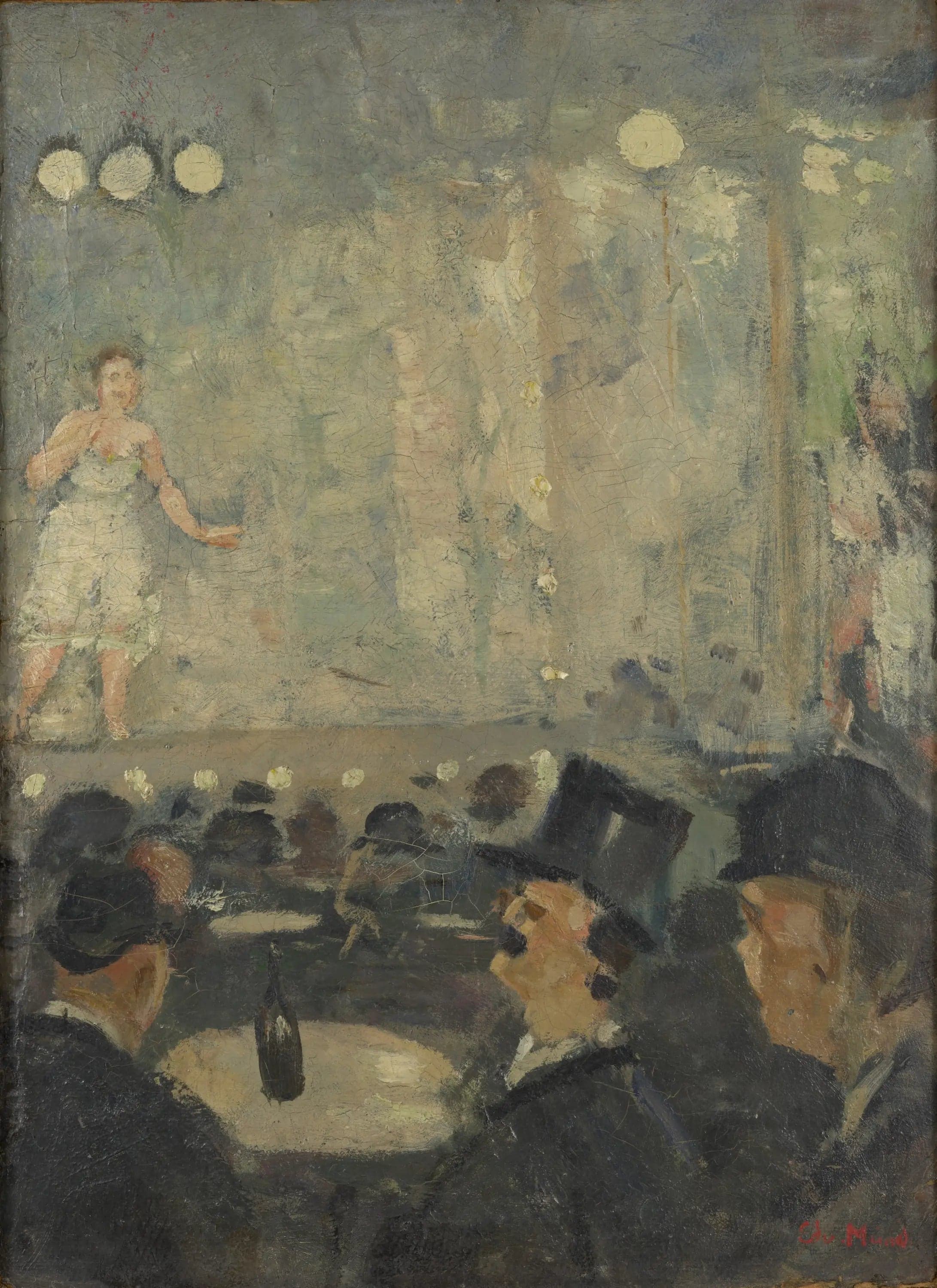
Cabaret
- Original dimensions
- 88 x 60.5 cm
- Museum
- Munch Museum
- Year
- 1895
Scene depicted
"Cabaret" is a pictorial work where Munch immerses us in a nocturnal world, bathed in dim lights and dancing silhouettes. The canvas reveals characters captivated by music, oscillating between joy and sorrow, symbolizing the duality of human life in a festive yet melancholic setting.
Historical context
Created in the heart of Oslo in 1895, this painting is emblematic of the expressionist movement, an artistic current that emerged in reaction to modernity. At that time, art liberated itself from conventions to capture raw emotions. The canvas "Cabaret" is currently housed in the Munch Museum, where it testifies to an intense creative period of the artist.
Place in the artist's career
This canvas marks a turning point in the career of Edvard Munch , interspersed between his major works such as "The Scream" and "The Madonna." It represents a stylistic peak, where brutal emotion blends with refined aesthetics, showing an evolution towards greater expressiveness.
Anecdote
“Art does not reproduce the visible; it makes visible.” This quote from Edvard Munch resonates particularly regarding the genesis of his masterpiece , born from a night of anguish and ecstasy at the heart of a vibrant cabaret. It is in this electric atmosphere that his painting captures the spirit of an era where pleasure coexists with melancholy.