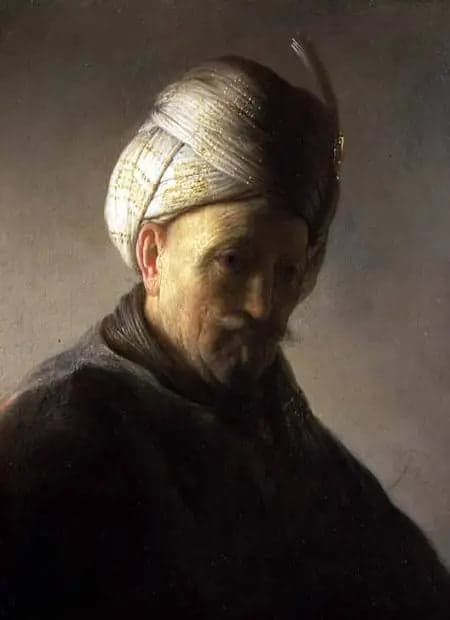
Bust of a man wearing a turban
- Original dimensions
- 20.3 x 26.7 cm
- Museum
- George Kremer
- Year
- 1628
Scene depicted
The painting “Bust of a Man Wearing a Turban” reveals a poignant portrait of a man whose captive gaze seems to convey a vast inner story. The turban, carefully draped, adds a dimension of exoticism and mystery, while the light highlights the features of his face, offering a striking glimpse into his personality.
Historical context
Created in Amsterdam in 1628, this painting is at the heart of the baroque movement, characterized by its dramatic play of light and rich emotions. At this time, Rembrandt stands out for his ability to capture human essence in a simple canvas . Currently, the canvas is preserved in the George Kremer museum, where it continues to inspire visitors with its visual intensity.
Place in the artist's career
This painting is situated at the beginning of Rembrandt 's career, a moment when he begins to assert his unique style. It foreshadows his later works, such as “The Night Watch” and “The Anatomy of Dr. Tulp,” illustrating a progression towards a bolder exploration of shadows and light.
Anecdote
“Light must speak, it must be listened to.” This quote from Rembrandt evokes the moment when the artist, one spring morning, finds himself facing the light that delicately illuminates the face of a man wearing a turban. This inspiration nourishes the composition of this masterpiece , where each brushstroke echoes a deep emotion.