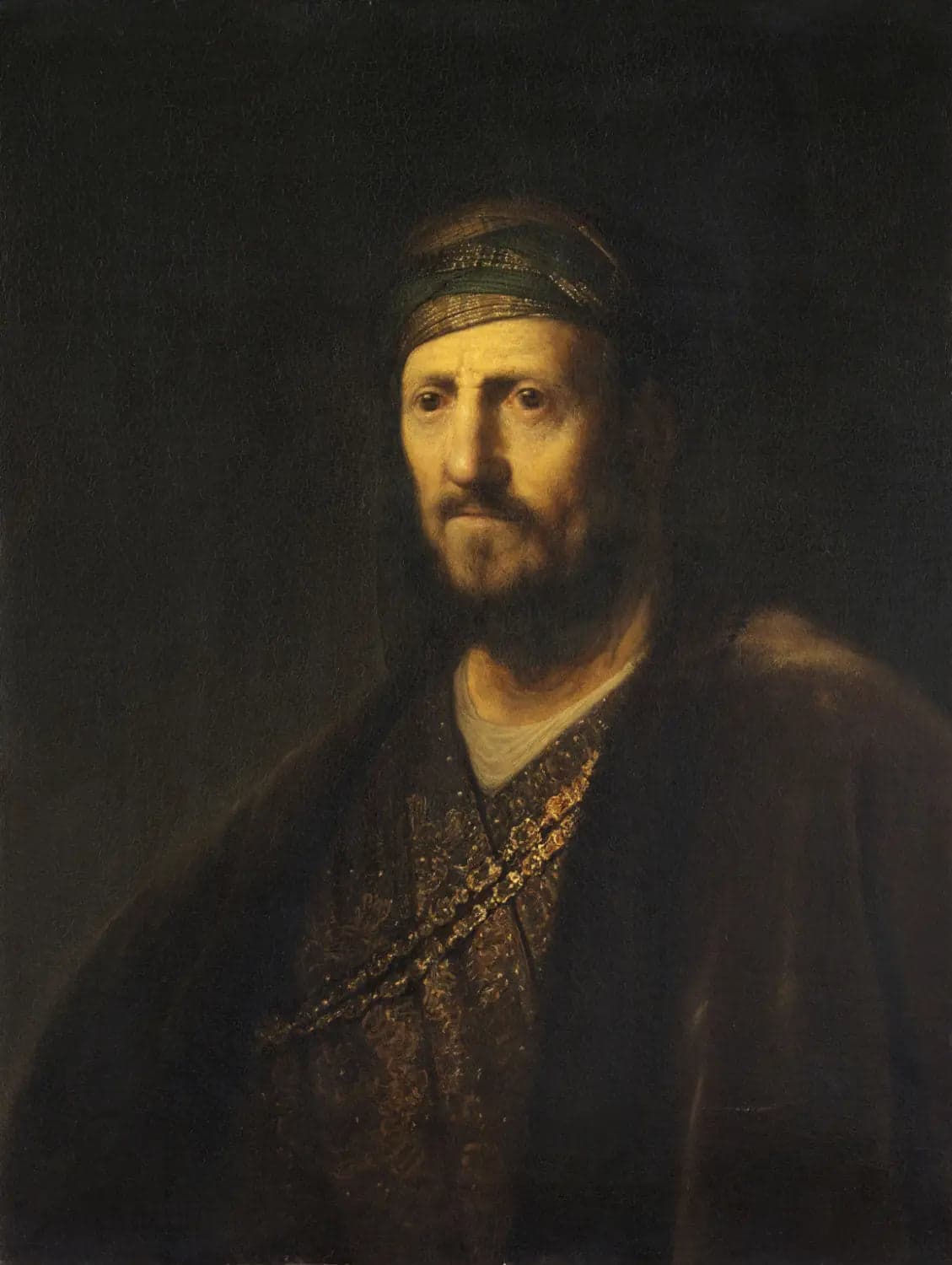
Bust of a man in oriental costume
- Original dimensions
- 64.5 x 84.9 cm
- Museum
- Philadelphia Museum of Art
- Year
- 1630
Scene depicted
This striking painting captures a man simultaneously anchored in the present and dreamlike in his gaze. The composition, centered on the expressive face of the subject, conveys the depth of the soul and the importance of the Eastern costume in his identity, revealing stories of distant travels and fascinating cultures.
Historical context
Created in 1630, this elegant painting finds its roots in the city of Amsterdam, at the heart of the Netherlands. Rembrandt , emblem of the Baroque , immerses us in a world where shadow and light dance, revealing the essence of the human soul. This painting, currently on display at the Philadelphia Museum of Art , measures 64.5 x 84.9 cm, embodying the artistic legacy of a bygone era while resonating with modernity.
Place in the artist's career
Bust of a Man in Eastern Costume is part of the mature period of Rembrandt , where his style reaches a remarkable peak. Alongside The Night Watch and the portrait of Saskia, this painting illustrates an evolution towards greater emotional and technical complexity, marking over time a deepening in the representation of characters.
Anecdote
“Art does not merely see; it feels, it expresses.” This fictional quote could well reflect the state of mind of Rembrandt when creating this masterpiece. Imagine him, on a sunny morning, wandering through the alleys of Amsterdam, a fleeting encounter with a man in Eastern costume, an emerging inspiration that will come to life on his canvas.