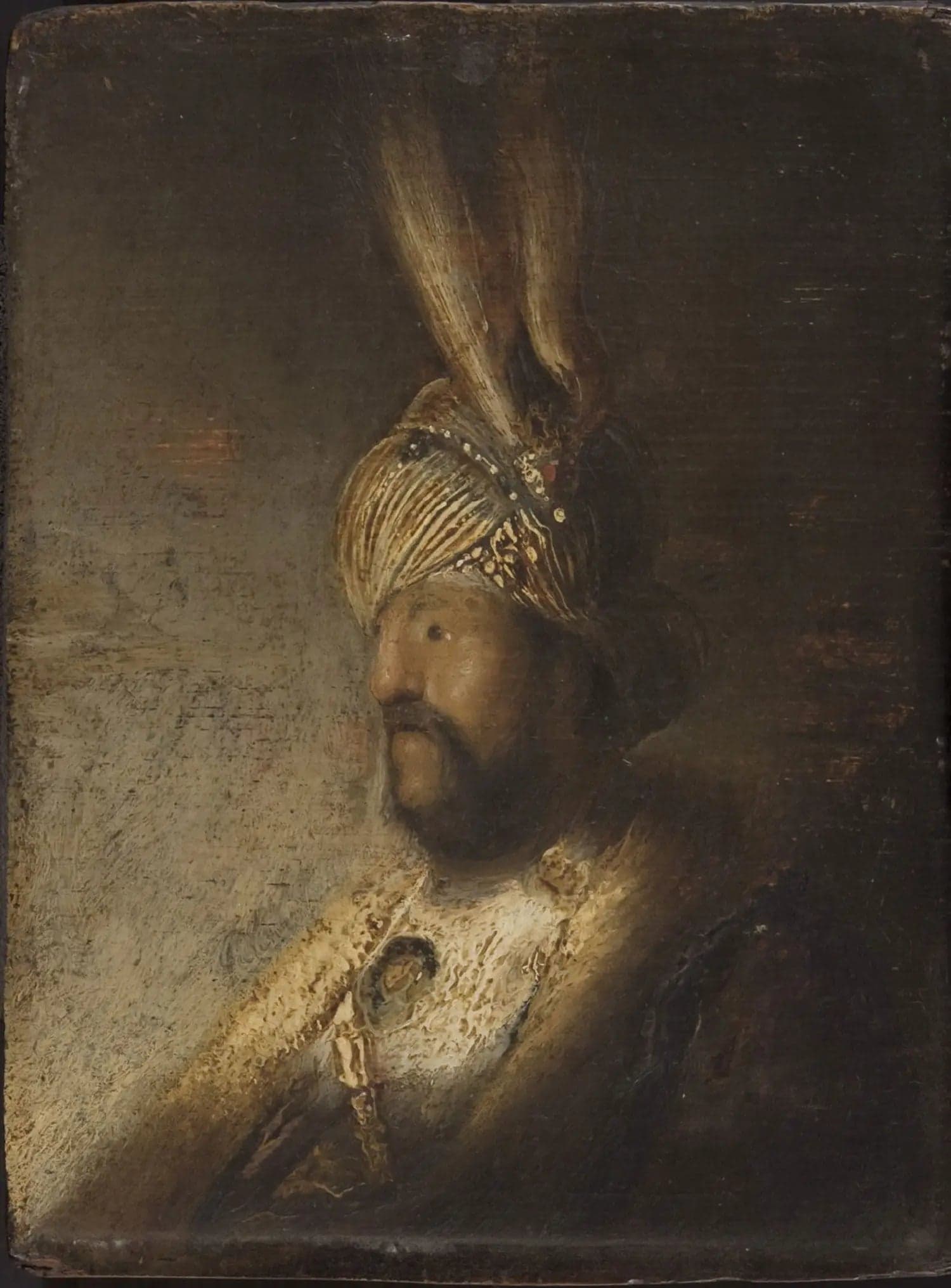
Bust of a man in a turban
- Original dimensions
- 13.3 x 17.3 cm
- Museum
- Philadelphia Museum of Art
- Year
- 1629
Scene depicted
In this canvas , Rembrandt offers a captivating portrait of a mysterious man wearing a turban. The face imbued with serene wisdom seems to tell a story with every brushstroke. The subtle details of the turban contrast with delicate shadows, while the model's expression evokes an emotional depth that transcends time. This painting takes us on a journey through the human soul, exploring the complexity of emotions that reside in every gaze.
Historical context
Created in 1629 during the golden period of Dutch art, this painting is emblematic of the baroque movement. Rembrandt , then a young artist in Amsterdam, managed to capture the richness of faces and the nuances of the human soul. The canvas is currently located at the Philadelphia Museum of Art , bearing witness to a story woven with light and shadows. Its dimensions of 13.3 x 17.3 cm make it an intimate canvas , inviting the viewer to a close introspection.
Place in the artist's career
The Buste d'homme au turban represents an important turning point in Rembrandt 's career, marking the beginning of his mastery of baroque portraiture. Through this painting , he positions himself alongside his future works such as “The Night Watch” and “Portrait of a Man in Black Costume,” highlighting his evolution as an artist. Each canvas testifies to his relentless pursuit of light and emotions, laying the foundations of his pictorial genius.
Anecdote
Rembrandt once said: “Light reveals what the soul hides.” Inspired by a face seen in an alley in Amsterdam, this masterpiece sprouted from a moment of gentle simplicity. One spring morning, the soft light played on the face of his model, prompting him to immortalize this ephemeral essence with passion in his painting .