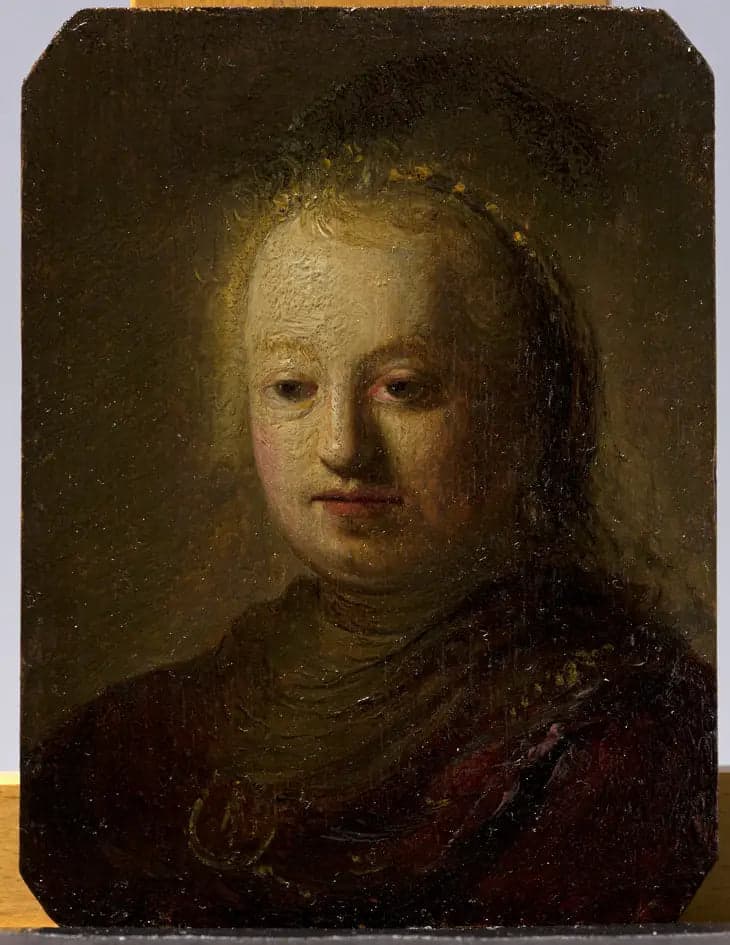
Bust of a Girl
- Original dimensions
- 10.5 x 14.5 cm
- Museum
- Groningen Museum
- Year
- 1630
Scene depicted
In "Bust of a Girl," Rembrandt captures a delicate youth, where innocence mingles with an enigmatic depth. The girl, in simple attire, evokes a timeless serenity. Her gaze, soft yet piercing, seems to invite you to discover the hidden thoughts behind her expression. The dark background highlights the luminous face, enhancing the emotional intensity of this painting .
Historical context
Created in 1630, the painting "Bust of a Girl" emerges from the workshop of Rembrandt in Amsterdam, a vibrant city of the early 17th century, at the heart of the artistic movement of Baroque . This era of artistic splendor marks a turning point in the history of art, and this canvas is a shining example. Today, this canvas is carefully preserved in the Groningen Museum, where it is admired for its timeless beauty and historical significance.
Place in the artist's career
This creation is a significant milestone in Rembrandt's career, illustrating his transition to stylistic maturity. At this time, the artist began to explore the subtleties of light and shadow, as shown in his other iconic paintings such as "The Night Watch" and "Self-Portrait." "Bust of a Girl" underscores his genius in transcribing the essence of human emotions.
Anecdote
“Light reveals the soul of people,” said Rembrandt , inspired by a ray of sunlight penetrating through an antique window. This perfect moment of revelation may well be the origin of this pictorial work , painting the gentle face of a girl who seems to have just emerged from a peaceful day, bathed in golden light.