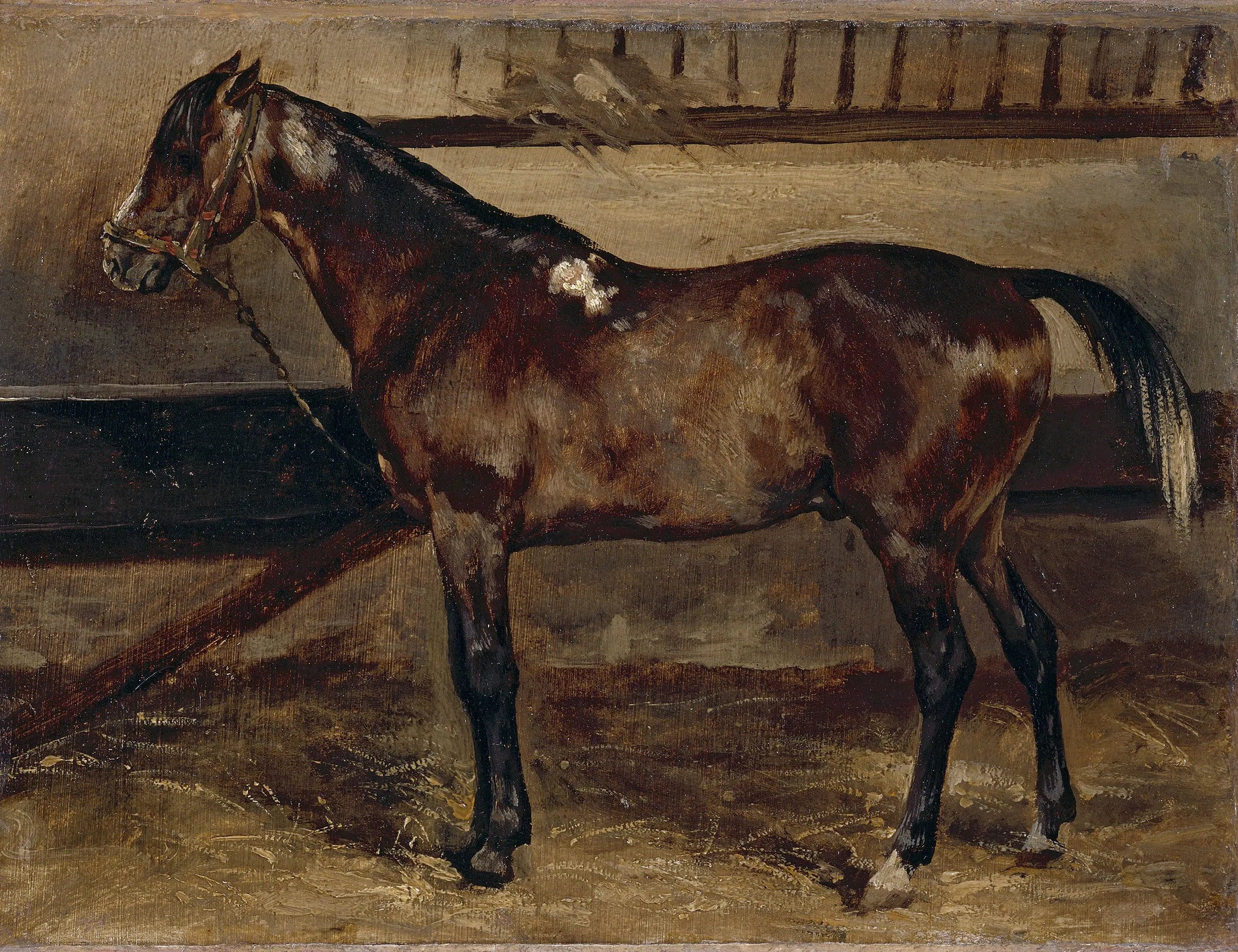
Brown Horse in the Stable
- Original dimensions
- 35 x 26.2 cm
- Museum
- Petit Palais
- Year
- 1818
Scene depicted
In this pictorial work, Géricault transports us into a stable, revealing a horse that appears both majestic and vulnerable. Its vibrant and animated features testify to a deep understanding of the animal, marking a visual narrative that evokes strength and gentleness, paying tribute to this noble creature.
Historical context
Artwork: Brown Horse in the Stable |BRK| Artist: Théodore Géricault |BRK| Year: 1818 |BRK| Museum: Petit Palais |BRK| Dimensions: 35 x 26.2 cm |BRK|
Place in the artist's career
The painting “Brown Horse in the Stable” is situated at a turning point in Géricault's career. Painted shortly after his iconic works such as “ The Raft of the Medusa ” and “ The Horse Race ”, this painting reveals not only the evolution of his technical mastery but also a shift towards an introspective sensitivity, marking a period of artistic maturation.
Anecdote
“The beauty of the horse lies not only in its appearance but in the soul it carries.” It was in a Parisian stable, in the early morning, that Géricault found inspiration for this masterpiece. The light filtering through the wooden slats created an intimate atmosphere, awakening emotions that would soon translate onto his canvas.