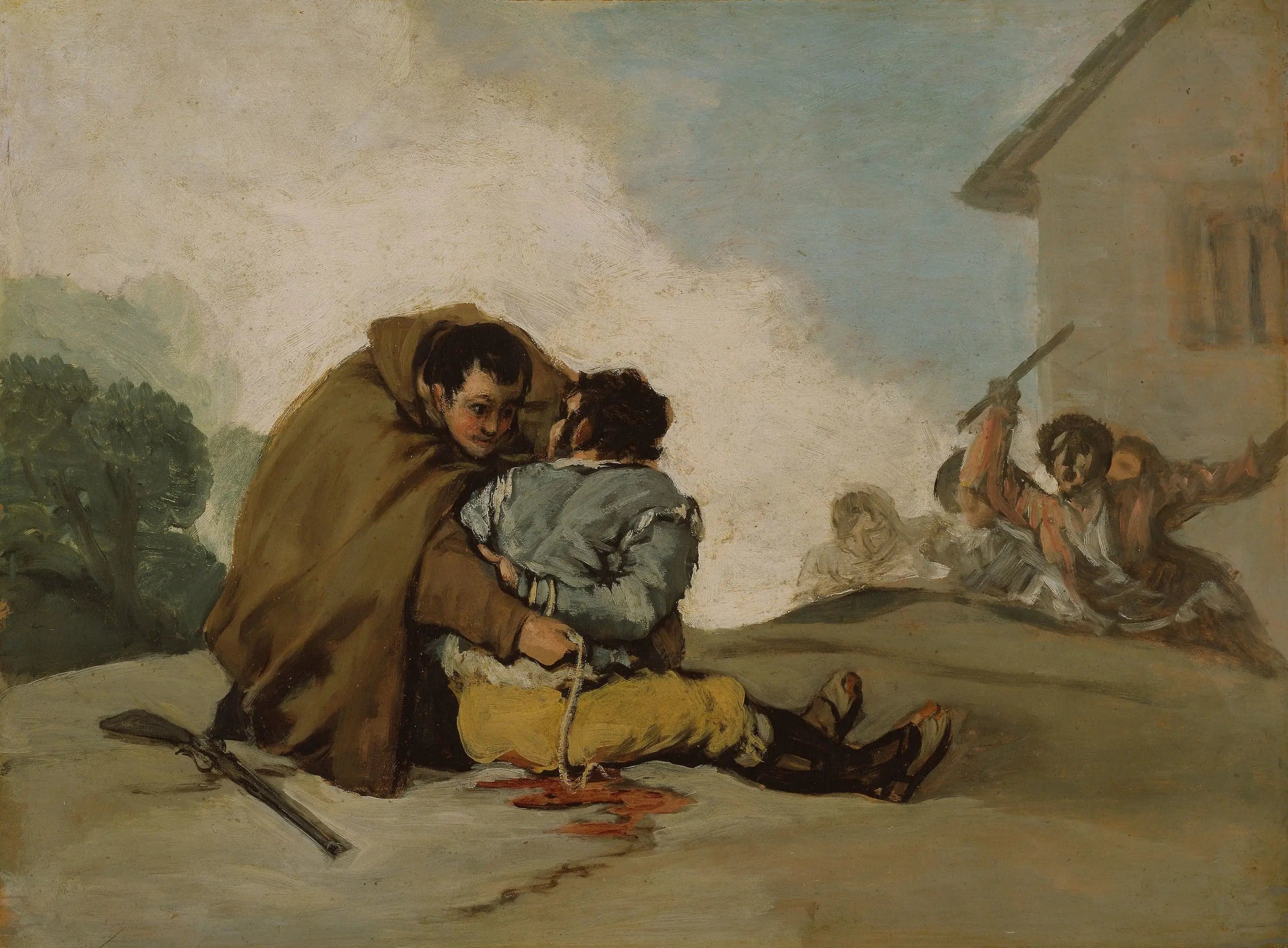
Brother Pedro ties El Maragato with a rope
- Original dimensions
- 38.5 x 29.2 cm
- Museum
- Art Institute of Chicago
- Year
- 1806
Scene depicted
In this canvas , Goya illustrates a dramatic landscape where Brother Pedro, the central character, shows a striking contrast between benevolence and authoritarianism. The image astonishes with its ability to convey complex emotions through a simple act of tying a rope, making palpable the underlying tension that permeates this pictorial work.
Historical context
Created in 1806, this painting is rooted in the vibrant context of Enlightenment Spain, at a time when the romantic movement was beginning to make its voice heard. Goya, a true pioneer, transposes the social and political malaise of his time into his work, thus offering a poignant reflection of his era. Currently exhibited at the painting of the Art Institute of Chicago , this masterpiece stands out with its dimensions of 38.5 x 29.2 cm.
Place in the artist's career
This painting is part of Goya's artistic maturity period, reflecting an increased mastery of light and form. The series “La Maja” and “The Disasters of War” also illustrate his technical and thematic evolutions, tracing a generational path through his expressive works.
Anecdote
“Humanity often allows itself to be trapped by its own chains, a tight rope symbolizing its fate.” This statement, attributed to Goya, perfectly evokes the moment he was inspired to paint the masterpiece . In a quiet alley of Madrid, cradled by the whispers of the surrounding valley, he captured the essence of human nature imprisoned in its own anxieties.