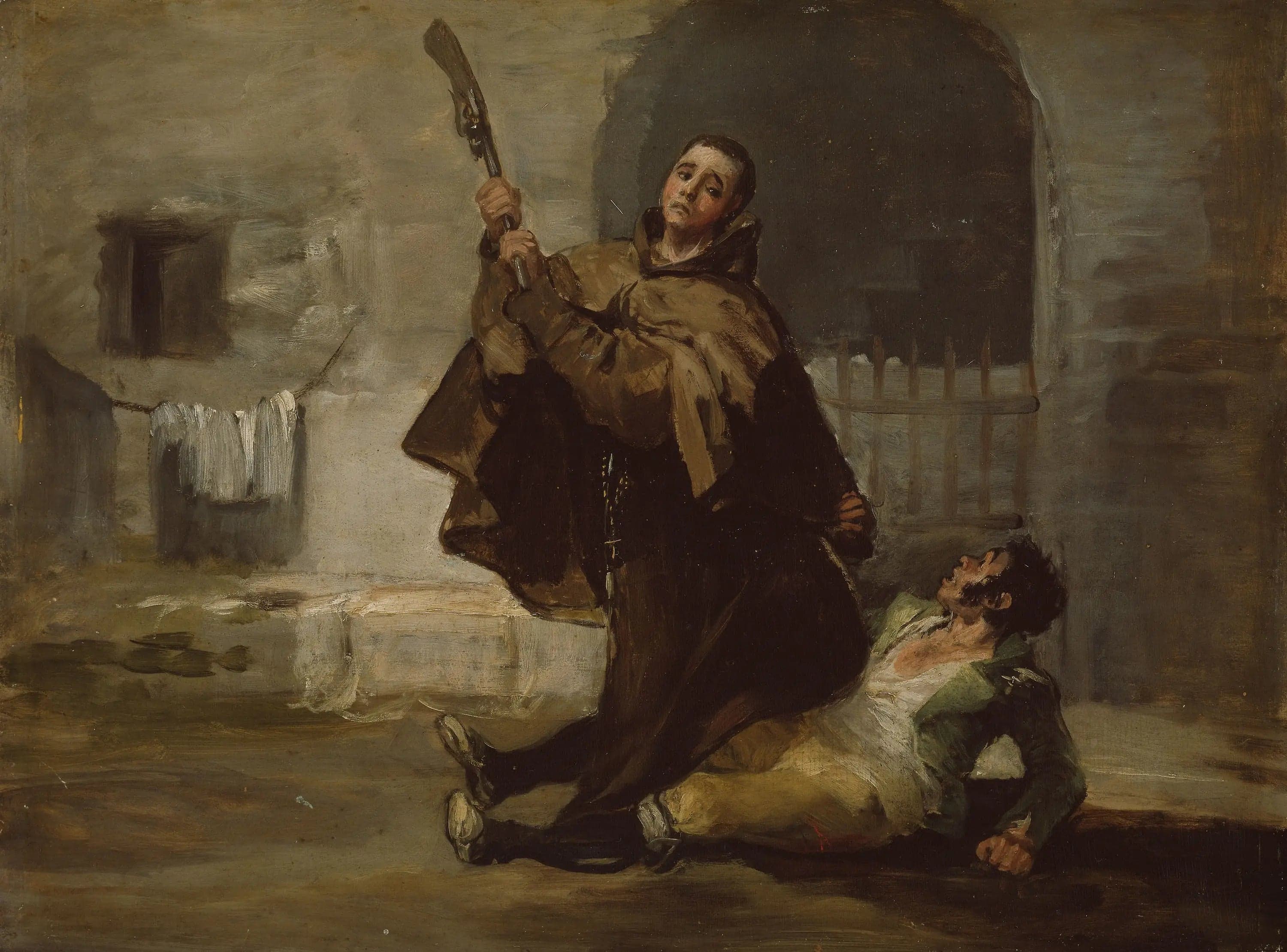
Brother Pedro strikes El Maragato with the rifle stock
- Original dimensions
- 38.5 x 29.2 cm
- Museum
- Art Institute of Chicago
- Year
- 1806
Scene depicted
The painting illustrates a dramatic episode of erudition, where the Inquisition and political conflicts intertwine. Goya captures the dramatic moment when Brother Pedro, a monk, strikes a man presumed to be El Maragato with the stock of his rifle. The palpable tension between the victim and his aggressor tells a story of injustice, oppression, and desperate struggle for survival. This painting aims to be both a narrative and a social critique.
Historical context
Created in 1806, this painting iconic emerges in the tumultuous context of Napoleonic Spain, in the heart of Madrid. Francisco de Goya , this emblematic figure of romanticism , inscribes his work in a rapidly changing artistic landscape. The place of conservation, the painting is currently exhibited at the Art Institute of Chicago, thus illustrating its radiance around the world, with dimensions that give it a striking presence in a space.
Place in the artist's career
This painting marks an important milestone in Goya's career, situated between his youthful works and his mature compositions. Comparable to his works such as La Maja Desnuda and The Disasters of War, this painting reveals an evolution of his style, touching on dark and introspective themes, while refining his technique.
Anecdote
Goya once said: “The painting is the reflection of souls.” This masterpiece was inspired by a scene from everyday life, where he perceived the pain and anger creeping on the faces of the oppressed. This moment of penetration into human existence resonates with the depth of the canvas , vibrant with emotions.