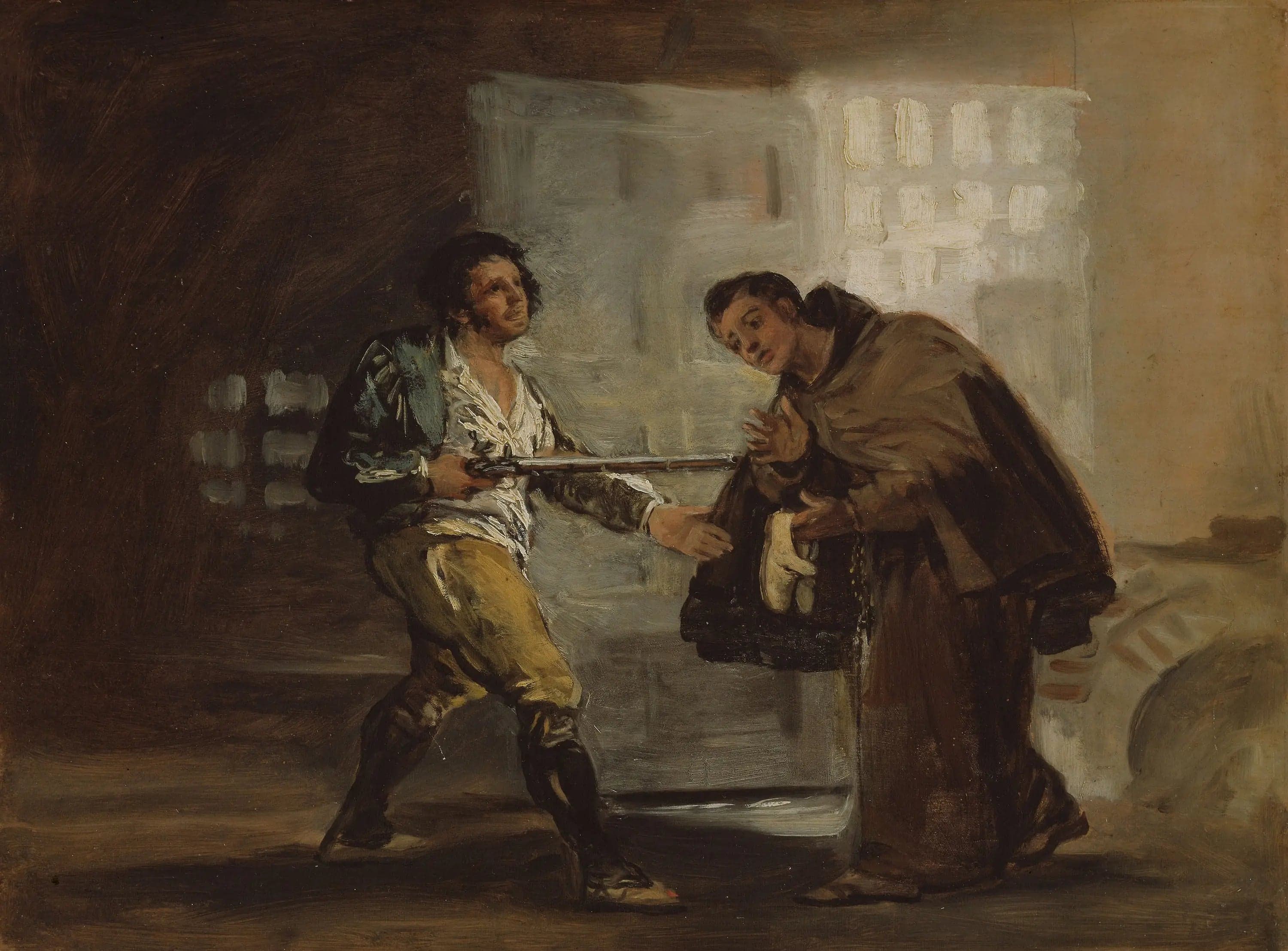
Brother Pedro offers shoes to El Maragato and prepares to put aside his weapon
- Original dimensions
- 38.5 x 29.2 cm
- Museum
- Art Institute of Chicago
- Year
- 1806
Scene depicted
The painting testifies to a fragile and tender moment, where Brother Pedro, a benevolent figure bearing generous intentions, offers shoes to El Maragato, a man in search of redemption. Their exchanged glances, filled with emotion, capture a moment of human connection, at the crossroads of misery and hope. Goya's gesture, imbued with delicacy, evokes the individual struggles integrated into a complex historical framework.
Historical context
Created in 1806, this painting is rooted in the heart of Spanish artistic tradition, precisely in Madrid, where Francisco de Goya , a master figure of romanticism , managed to capture the social and human concerns of his time. This painting, currently housed at the Art Institute of Chicago, is part of the realism movement, paying particular attention to the psychological nuances of its subjects, thus revealing a troubled era in deep introspection.
Place in the artist's career
This painting represents a major milestone in Goya's journey, oscillating between realism and romantic emotion. Through works like "The Executions of May 3, 1808" and "The Naked Maja," he illustrates the torments and echoes of the human condition. Brother Pedro offers shoes to El Maragato, although less known, reveals an equivalent psychological depth, initiating a more intimate reflection on human resilience.
Anecdote
“The truth of man lies in his actions,” said Goya, echoing his inspiration at the turn of a street in Madrid. One morning at dawn, faced with a moving scene of solidarity, he rushed to immortalize this masterpiece. In his mind, this canvas was not just a simple representation, but a tribute to human dignity.