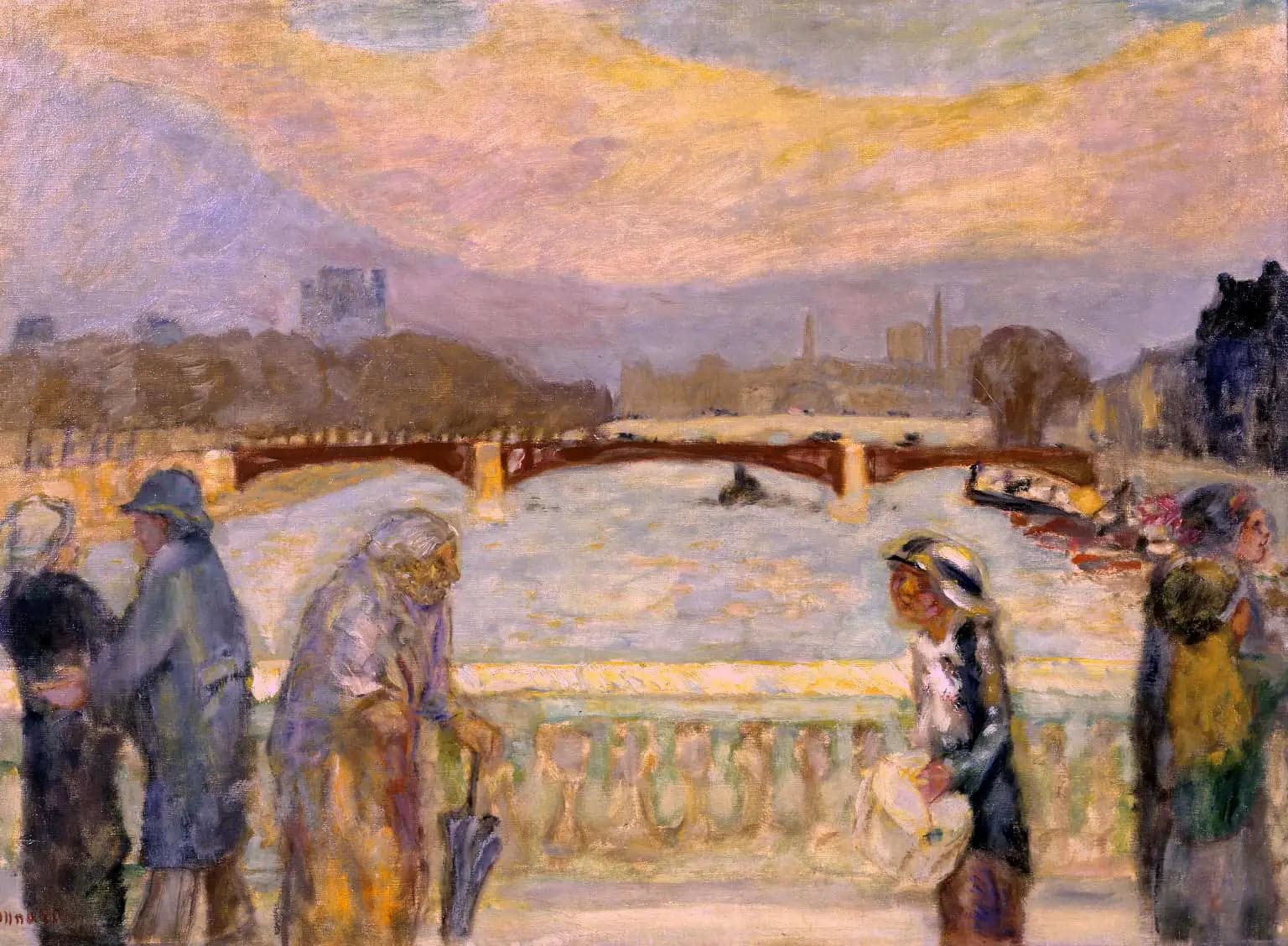
Bridge of the Concorde
- Original dimensions
- 60 x 83.2 cm
- Museum
- Tate
- Year
- 1913
Scene depicted
In "Pont de la Concorde," Bonnard captures the animation and serenity of an urban scene. The painting invites contemplation of the famous bridge that connects the banks of the Seine, uniting the flowing waters with the bustling life of Paris. The painting depicts pedestrians strolling under the warm light, their harmonious silhouettes blending into the landscape. The atmosphere invites daydreaming, making the viewer a traveler at the heart of the city of lights.
Historical context
Created in 1913, the painting "Pont de la Concorde" is a vibrant testimony of Fauvism , a passionate artistic movement that advocates the expression of emotions through color. Located in Paris, the cradle of artists of the time, this iconic work is now housed in the Tate Museum in England. Measuring 60 x 83.2 cm, this canvas captures the very essence of urban life at this turning point of the 20th century.
Place in the artist's career
The canvas "Pont de la Concorde" marks a significant milestone in Bonnard's career, illustrating a stylistic peak of his Fauvist period. Two other canvases , "Le Nu jaune" and "La Terrasse," can be paralleled, showing his evolution towards increasingly bold compositions that explore light and color.
Anecdote
"Art must be a reflection of life, an invitation to feel." These words resonate as an echo of Bonnard's inspiration, who may have captured the magic of a Parisian spring morning, where light plays on the waters of the Seine, transforming each moment into a vibrant pictorial work .