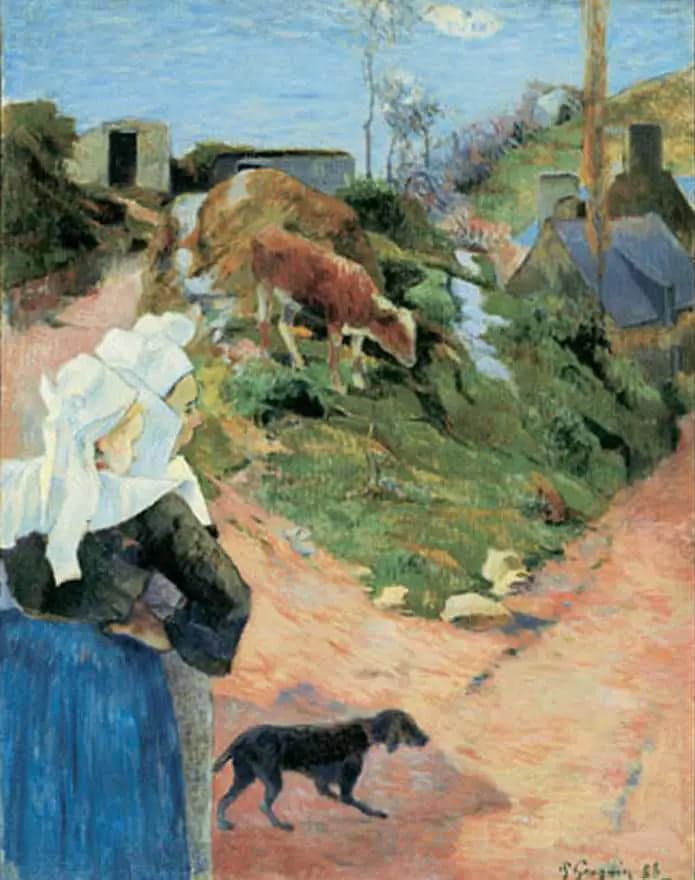
Breton Women at the Turn of a Road, or Breton Women and Calf
- Original dimensions
- 72 x 91 cm
- Museum
- Ny Carlsberg Glyptotek
- Year
- 1888
Scene depicted
This painting famously depicts Breton women dressed in traditional costumes, strolling at a bend in the road, accompanied by a calf. This aesthetic composition catches the eye and invites the viewer to dive into the pastoral and tranquil universe of Brittany, while hinting at the depth of the region's cultural traditions.
Historical context
Painted in 1888, this canvas emblematic of Paul Gauguin illustrates the creative climate of the late 19th century in the Brittany region of France. At that time, he was part of the synthetist movement, marking a transition to a more symbolic approach to painting . Currently, this painting resides in the prestigious Ny Carlsberg Glyptotek museum, where it continues to inspire art enthusiasts.
Place in the artist's career
Positioned at the crossroads of his career, Bretonnes au tournant d'une route marks a crucial step towards the mature style that would define Gauguin. Alongside Vision after the sermon and The nap , this painting demonstrates the evolution of his pictorial language and his commitment to capturing the essence of rural life, while experimenting with vibrant colors and bold composition.
Anecdote
“I have always believed that each color tells a story,” Gauguin stated on the day he, inspired by the simple beauty of the Breton women, sketched the first idea of his masterpiece . Imagine a spring morning, the song of birds resonating among the fields, and the image of village figures, evoking the serenity of rural life, taking shape on his canvas .