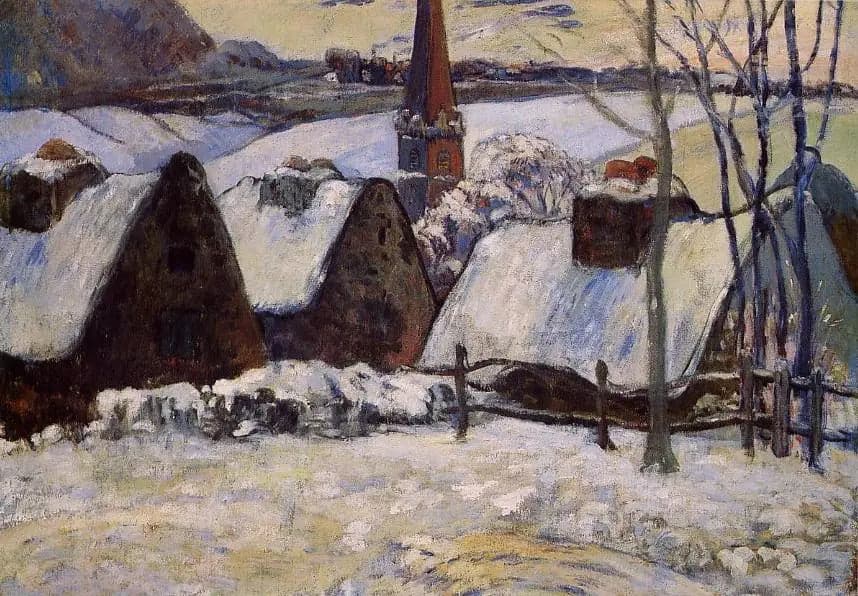
Breton Village Under the Snow
- Original dimensions
- 87 x 62 cm
- Museum
- Pont-Aven Museum
- Year
- 1894
Scene depicted
In the canvas “Breton Village under the Snow,” Gauguin captures the essence of Brittany's landscapes, wrapped in a soft white blanket. Historical houses with traditional shapes, frozen under the snow, are bathed in a gentle light that seems to highlight the textures of the snow and the authenticity of this region. The work reflects a peaceful, almost poetic atmosphere, where time seems suspended.
Historical context
Created in 1894, in the heart of Brittany, this painting is emblematic of the symbolist movement, also known as post-impressionism . It was in Pont-Aven, a village famous for its authentic atmosphere and enchanting landscapes, that Gauguin conceived this canvas , now exhibited at the Pont-Aven Museum. Its dimensions, 87 x 62 cm, make it an imposing work that attracts the eye and invites contemplation.
Place in the artist's career
This canvas is part of a phase of artistic maturity for Gauguin, illustrating his shift towards a more symbolic and colorful interpretation. With works like “Vision After the Sermon” and “The Beautiful Angèle,” this painting testifies to the evolution of his style, marking a key stage in his career as a bold and innovative artist.
Anecdote
“Beauty lies in the simplicity of things,” Gauguin said, inspired by the calm of a winter morning, when the snow delicately covers the roofs of Breton houses. This fleeting moment of peace and solitude is at the heart of the painting , where each brushstroke evokes the magic of nature in winter.