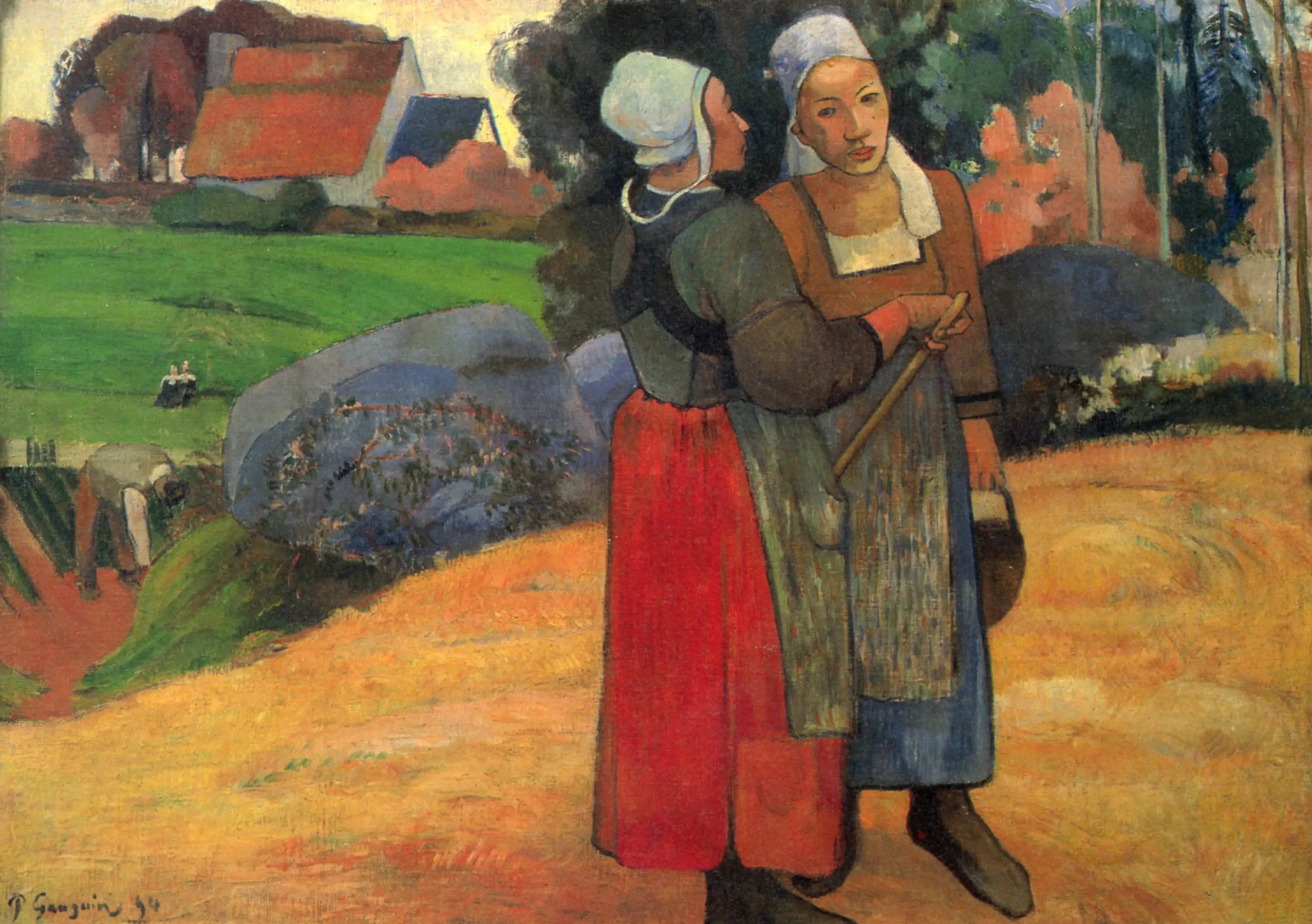
Breton Peasant Women
- Original dimensions
- 92.7 x 66.5 cm
- Movement
- School of Pont-Aven
- Museum
- Orsay Museum
- Year
- 1894
Scene depicted
“Breton Peasants” illustrates the daily life of several women working in the fields. In a rich and vibrant palette, Gauguin depicts figures that one might believe are frozen in time, attending to rural tasks. The painting evokes the harmony between humans and their landscapes, a relationship that, although laden with labor, becomes a source of beauty and respite.
Historical context
Created in 1894, this painting emblematic was born in Pont-Aven, a Breton village that inspired many artists. Gauguin, a leading figure of the School of Pont-Aven, captures the essence of a people and a land through this canvas which is currently at the Orsay Museum . This masterpiece measures 92.7 x 66.5 cm and stands out as a milestone in the pictorial creation of the late 19th century.
Place in the artist's career
This canvas fits into a pivotal period of Gauguin's career, one where he begins to move away from naturalism to explore bolder techniques and brighter palettes. Looking at works like “Vision after the Sermon” and “La Arearea”, one can perceive in “Breton Peasants” an evolution of his creative process, where color and form take on equal importance to the subject.
Anecdote
“The light of Brittany is for me an endless journey.” This quote could summarize the spirit of creation that inhabited Gauguin during the delivery of his masterpiece . Imagine a spring morning in Pont-Aven, where the wheat fields dance under the gentle breath of the wind. It is this fleeting moment that nourished the inspiration for this painting , engendering an evocative force that transcends time.