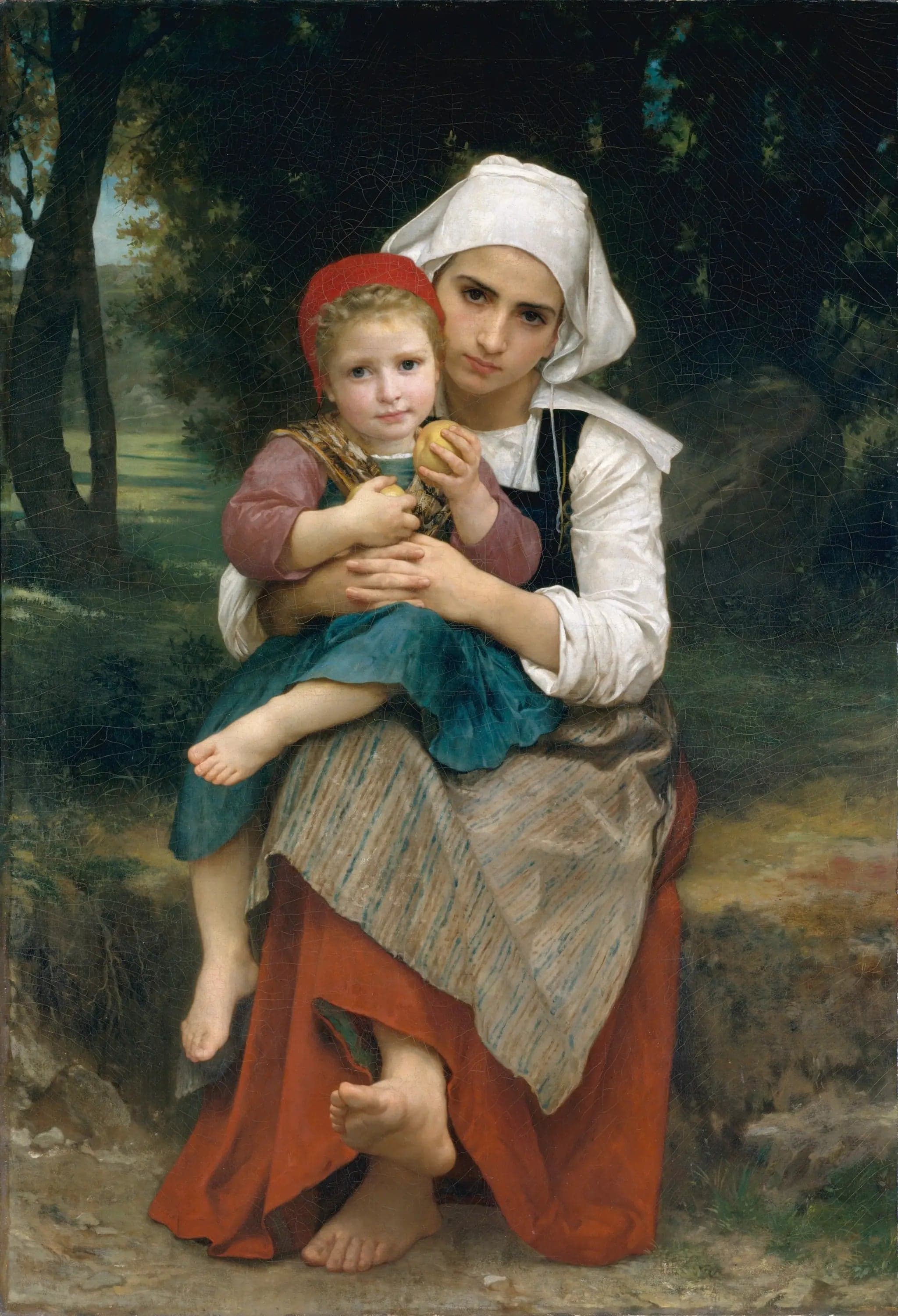
Breton Brother and Sister
- Original dimensions
- 89.2 x 129.2 cm
- Movement
- academicism
- Museum
- Metropolitan Museum of Art
- Year
- 1871
Scene depicted
In this painting , Bouguereau depicts two Breton children, their complicity expressed through their natural postures and their gazes framed in a gentle play of light. The scene portrays not only a sibling bond but also an immersion in the vibrant colors of their environment, highlighting the harmony that reigns in rural daily life. Every detail, from traditional clothing to joyful expressions, tells a timeless story of simplicity and happiness.
Historical context
Created in 1871, this painting is emblematic of the academic movement, famous for its devotion to the expression of human beauty and technical mastery. Located at the Metropolitan Museum of Art in New York, this canvas measures 89.2 by 129.2 cm, capturing a precious moment in the daily life of Brittany. The artist, William-Adolphe Bouguereau , draws his inspiration from the authenticity of a time when painting was seen as a reflection of society and its cultural heritage.
Place in the artist's career
“Brother and Sister Bretons,” an iconic figure of Bouguereau's mature period, stands alongside other stunning compositions like “The Woman and the Child” and “The Pilgrimage to the Holy Family.” This canvas , while distinguished by its emotional expression, shows a technical evolution; Bouguereau perfecting his ability to capture light and the anatomical details of human figures.
Anecdote
“Nature is my best teacher,” said Bouguereau. The inspiration for the masterpiece “Brother and Sister Bretons” comes from a sunny day in a small village in Brittany. Around a picturesque alley, he encounters the knowing gaze of a brother and sister, embodying the innocence and purity of childhood, which inspires him to create this moving composition.