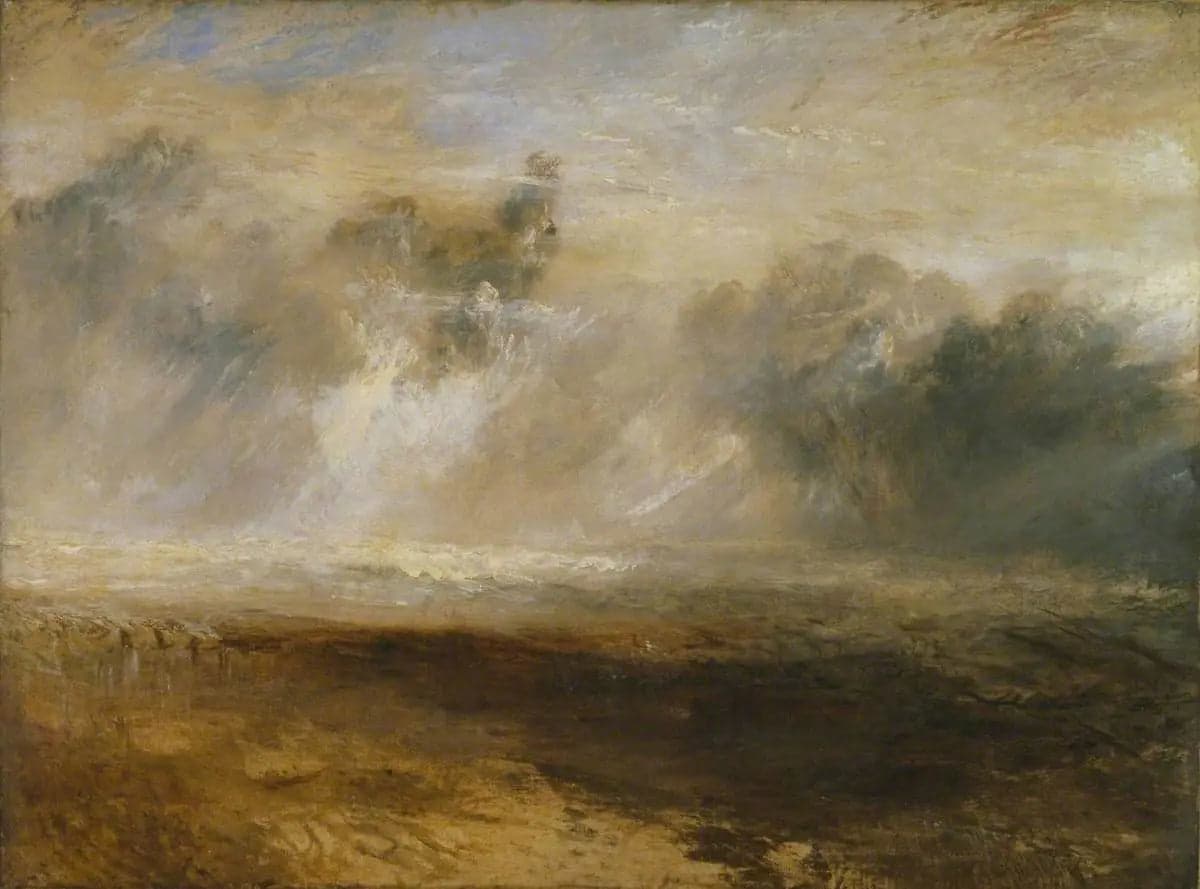
Breakers on a Flat Beach
- Original dimensions
- 90.2 x 121 cm
- Museum
- Tate
- Year
- 1837
Scene depicted
The painting "Breakers on a Flat Beach" depicts a gloomy beach where the waves break on the sand, revealing both the power of the sea and the softness of the landscape. The equestrian silhouettes, measured against the vastness of the water, evoke the unbreakable bond between man and nature, a universal message that Turner conveyed with unmatched finesse.
Historical context
Created in 1837, the painting "Breakers on a Flat Beach" is at the heart of the British romantic movement, a time marked by a return to nature and the expression of emotions. Turner, based in London but influenced by the coastal landscapes of his youth, captured the majesty of the waves on the shore. Today, this iconic work holds a prominent place at the Tate in London, a place where art and history meet, measuring 90.2 by 121 cm.
Place in the artist's career
"Breakers on a Flat Beach" is situated at a pivotal moment in Turner's career, marking both his artistic maturity and the meeting of his unique vision with the technical challenges of light and color. Alongside the famous "The Fighting Temeraire" and "Rain, Steam and Speed," this canvas showcases his stylistic evolution as he navigates towards new pictorial explorations.
Anecdote
“The sea is a living spectacle, it inspires me every day.” This quote from Turner resonates with the very spirit of his masterpiece . During a walk by the sea on a sunny morning, he saw the waves crashing powerfully, a moment of beauty and contemplation that gave birth to the painting in question.