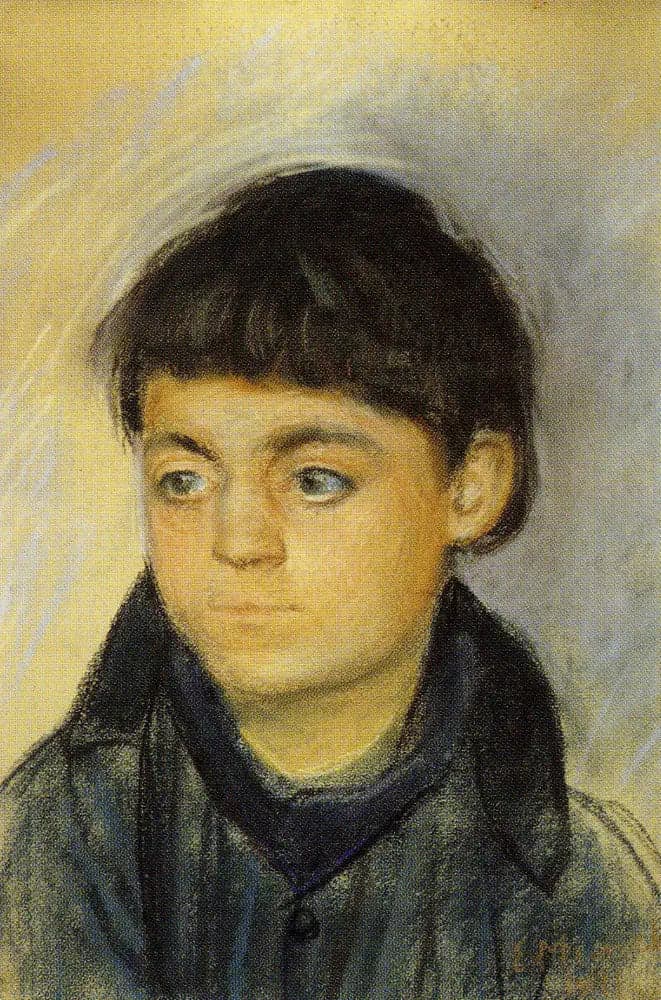
Boy's Head
- Original dimensions
- 27 x 40 cm
- Museum
- Not specified
- Year
- 1882
Scene depicted
In the painting Boy's Head , Munch gives a poignant presence to a young face, illustrating an intimate reflection imbued with melancholy. This canvas explores both the innocence and fragility of youth, where each brushstroke seems to whisper stories of carefreeness and vulnerability. The delicate composition invites the viewer to contemplate the depth of emotions expressed through the boy's eyes, a reflection that is both mysterious and fascinating.
Historical context
Created at the heart of the late 19th century, the iconic painting Boy's Head by Edvard Munch reflects a time of emotional and artistic upheaval. In a Europe shaken by avant-garde movements, Munch, originally from Norway, aligns himself with the Symbolist movement through works that explore the human psyche. The canvas, currently in a private collection, captures deep dimensions, both human and artistic, measuring 27 x 40 cm.
Place in the artist's career
The Boy's Head is situated at a promising turning point in Edvard Munch 's career, a moment when his style begins to crystallize. Alongside works such as The Scream and The Madonna , this canvas shows the growing maturity of his art, as well as a unique ability to capture the essence of human emotion. Juxtaposing them reveals a technical and expressive evolution over time.
Anecdote
“I believe that what one feels is more important than what one sees,” Munch might have said, recalling the emotions that inspired him that morning in a quiet street. The soft light caressed his inspiration, giving birth to this poignant work . The Boy's Head is the fruit of this vibrant understanding of life and its fragile essence.