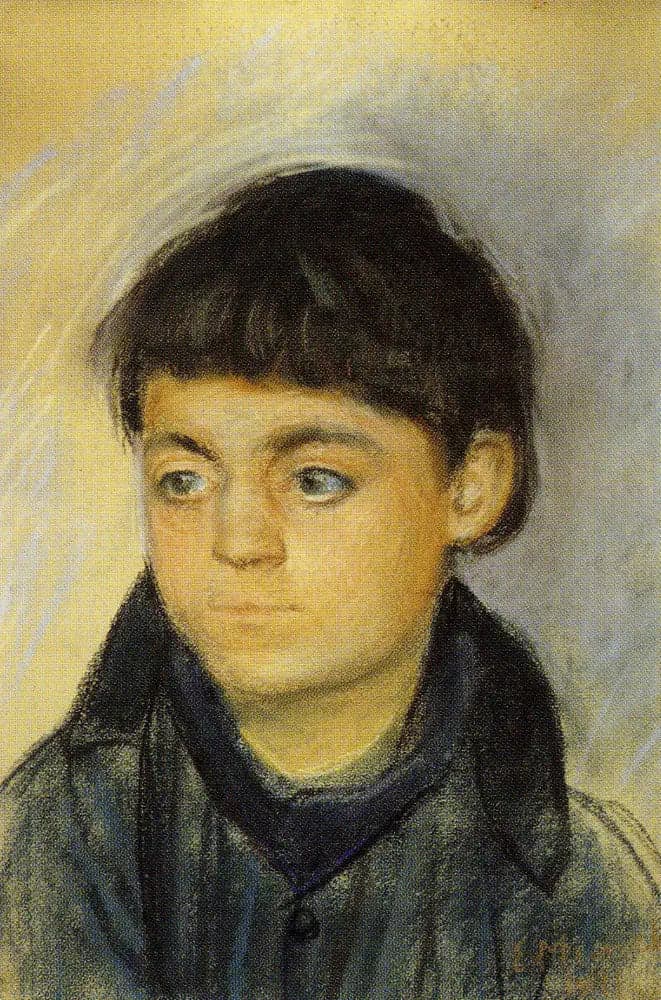
Boy's Head
- Original dimensions
- 29.5 x 40.5 cm
- Museum
- Moss Kunstforenings kunstsamling
- Year
- 1891
Scene depicted
In the painting "Boy's Head," Munch captures the innocence and fragility of childhood. Shadowy figures, soft light, the boy's face merges with a melancholic atmosphere, projecting a fascinating psychological depth. The delicate features and thoughtful gaze invite the viewer to immerse themselves in a world of reflections on youth, solitude, and the search for identity.
Historical context
Created in 1891 in the peaceful town of Moss, Norway, the painting "Boy's Head" is part of the expressionist movement, a movement dear to Edvard Munch . At that time, the artist, already sensitive to the profound duality of the human soul, captures with a rare emotional intensity the very essence of youth. This canvas is now part of the collection of the Moss Kunstforenings, a true showcase of art, where each painting tells a vibrant story.
Place in the artist's career
"Boy's Head" stands as a pivot in Munch's career, revealing both his emerging technical mastery and his penchant for expressing inner emotions. In comparison, his painting "The Scream" and his series "The Frieze of Life" highlight a bold evolution towards more complex compositions, while maintaining this emotional exploration that characterizes him.
Anecdote
“The beauty of a face can express emotions deeper than a poem.” This quote could very well resonate with Munch's inspiration during a quiet morning, when he crossed the gaze of a young boy in an alley bathed in golden sunlight. This fleeting encounter, like a shooting star, marked the genesis of the masterpiece "Boy's Head"; the evocative power of this gaze is evident in every brushstroke.