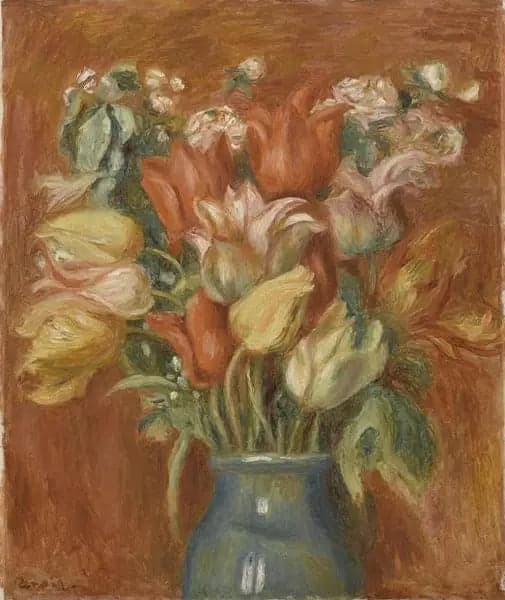
Bouquet of Tulips - Pierre
- Original dimensions
- 37 x 44 cm
- Museum
- Orangerie Museum
- Year
- 1905
Scene depicted
Renoir's painting “Bouquet of Tulips” unfolds a composition rich in colors that invites wonder. The tulips, a symbol of renewal, stand proudly in a vase, like a true celebration of nature. The artist's light and delicate touch makes each petal vibrate and creates a visual harmony that warms the heart. The scene is imbued with a serenity that evokes the sweet spring mornings, filled with the promises of a new season.
Historical context
Created in 1905, this painting reflects a rich and vibrant period in the history of art, during the height of the Impressionist movement, in the beautiful city of Paris. The canvas currently finds its place at the Orangerie Museum , where it continues to inspire generations of admirers. Its dimensions of 37 x 44 cm make it an artwork that is both intimate and grand, capturing the ephemeral essence of a bouquet of tulips.
Place in the artist's career
Inscribed in Renoir's career as an emblematic work, the canvas “Bouquet of Tulips” stands as a stylistic peak of his Impressionist period. In the face of works such as “Luncheon of the Boating Party” and “The Bathers,” one discovers an evolution both technical and emotional, where light and color take a predominant place, amplifying the expression of the beauty of everyday life.
Anecdote
“Beauty lies in light and color.” These words from Renoir resonate deeply as he evokes the unique moment of creating this masterpiece . Imagine a sunny morning, when the tulips bloom under the gentle spring warmth, where each petal seems to dance under the caress of a light breeze. This energy is captured in the painting itself, an ode to the fleeting beauty of life.