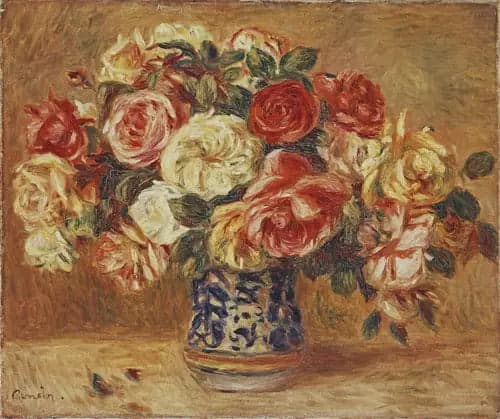
Bouquet of Roses - Pierre
- Original dimensions
- 65.7 x 83.1 cm
- Museum
- Clark Art Institute
- Year
- 1879
Scene depicted
In "Bouquet de roses," Renoir transports us to a vibrant garden where light dances on delicate petals. This painting unfolds a harmony of colors and textures, capturing the fleeting essence of flowers, each rose transforming into a palpable emotion, creating an atmosphere that is both warm and welcoming.
Historical context
Created in the year 1879, this painting is emblematic of the impressionist movement flourishing at the time, rooted in the beautiful city of Paris, in the heart of France. This canvas currently resides at the Clark Art Institute , where its brilliance and delicacy continue to captivate visitors. The generous dimensions of this canvas allow for a total immersion in its floral universe, a vibrant celebration of natural beauty.
Place in the artist's career
"Bouquet de roses" is situated in a crucial phase of Renoir's career, illustrating both his impressionist style and his quest for color harmony and light. It juxtaposes with other works like "Les Fêtes de Giverny" and "Baigneuses," where one can observe the evolution of his treatment of color and luminosity on the canvas.
Anecdote
As Renoir said, "Painting is a poetry that is seen rather than felt." Imagine a spring morning when he came across vibrant flowers in a lush garden. This vision breathed life into this masterpiece , creating a pictorial work that evokes joy and lightness, like a sweet melody.