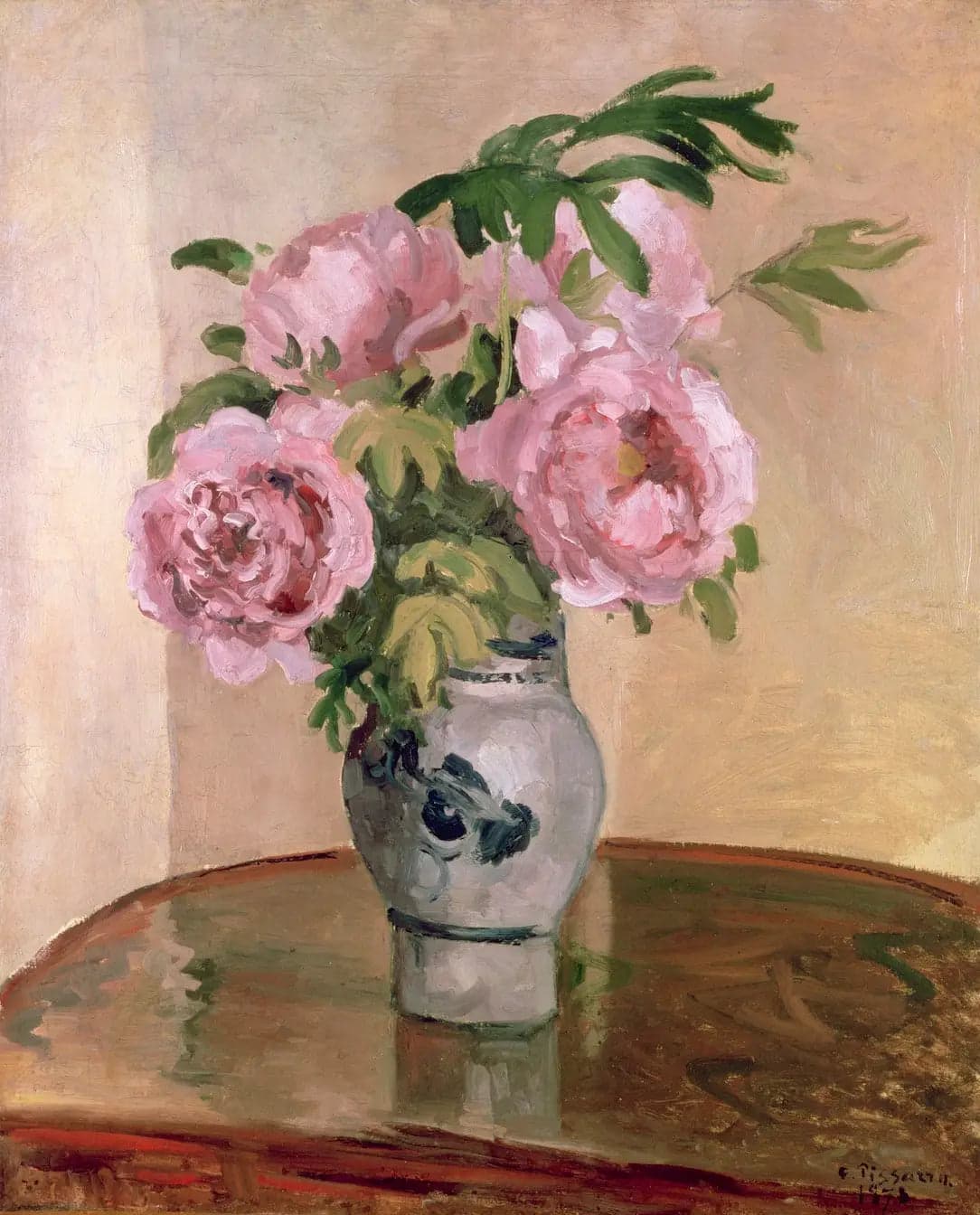
Bouquet of Pink Peonies
- Original dimensions
- 60 x 73 cm
- Museum
- Ashmolean Museum
- Year
- 1873
Scene depicted
“Bouquet of Pink Peonies” presents a sumptuous explosion of flowers, witnessing a moment of calm and elegance. The vivid petals capture light in a striking way, where the texture of the flowers and their delicate coloring evoke a sense of serenity. This composition is a true ode to nature, a leap into a lush garden where the ephemeral beauty of peonies mingles with the sweetness of spring air.
Historical context
Created in 1873, in Oxford, in the iconic region of England and at the heart of the Impressionist movement, the painting "Bouquet of Pink Peonies" by Camille Pissarro is set in a time when light and color are celebrated in an unprecedented way. This canvas , now displayed at the Ashmolean Museum , captures the artist at a pivotal moment in his journey, where he fully explores the subtleties of visual perception. In this work , every skillfully orchestrated detail resonates with the ephemeral beauty of nature.
Place in the artist's career
This canvas marks a significant milestone in Pissarro's career. In parallel with “The Harvest” and “Boulevard Montmartre, Spring,” we observe a maturation of his style, a subtle shift from naturalistic representation to a more vibrant and lively expression. “Bouquet of Pink Peonies” stands as a reflection of his artistic quest for light and color, reinforcing his status as a forerunner of the Impressionist movement.
Anecdote
“Beauty lies in the passion of fleeting moments.” This quote from Pissarro evokes the radiant summer when this masterpiece was born. Imagine a sunny morning, the rays of light caressing the delicate peonies, filling the air with an intoxicating floral scent; this fleeting moment, immortalized in the painting , resonates deeply thanks to the sensitivity and technique of the artist.