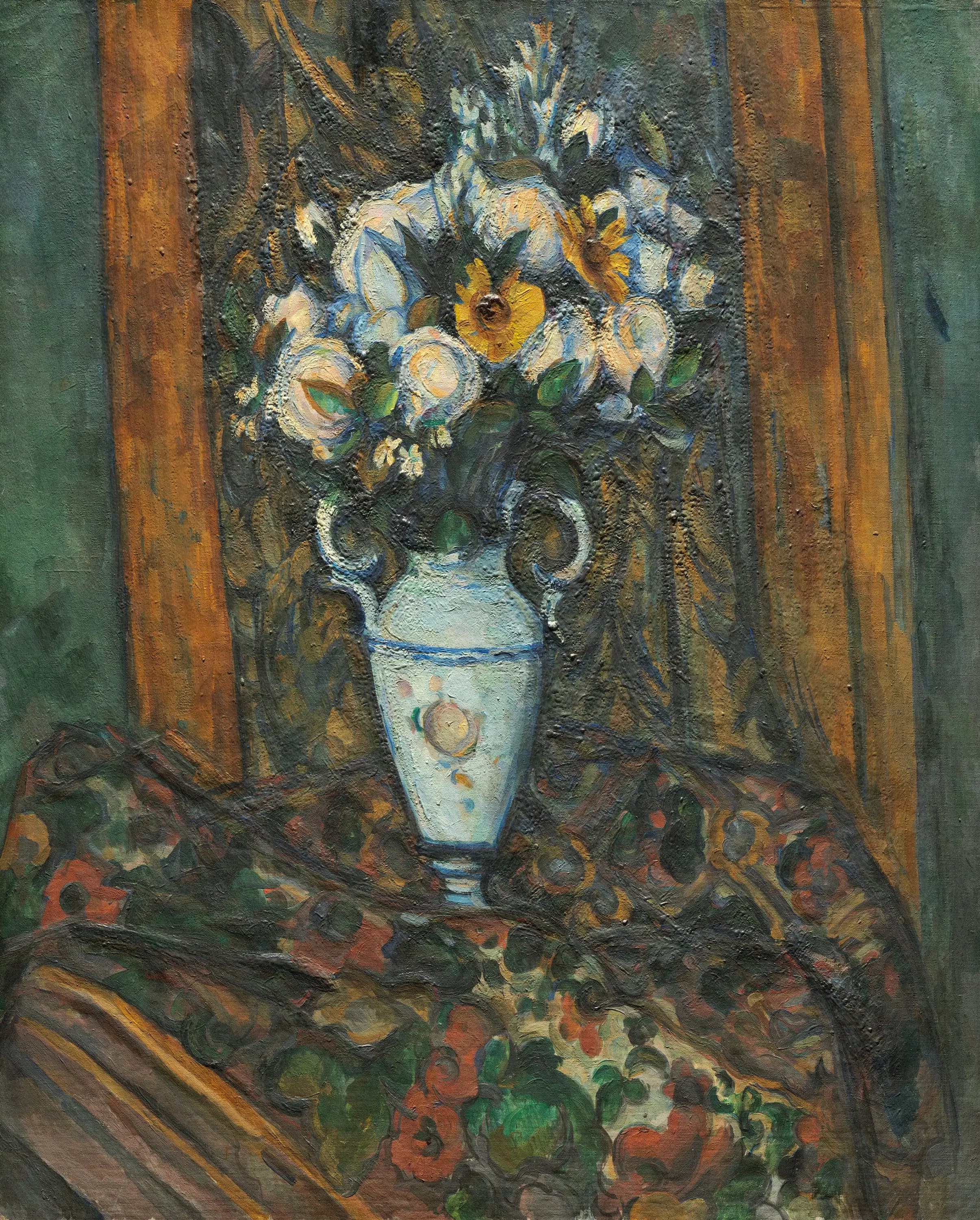
Bouquet of flowers
- Original dimensions
- 81.9 x 101 cm
- Museum
- National Gallery of Art
- Year
- 1902
Scene depicted
In this canvas , the viewer is invited to dive into a flourishing universe, where roses, tulips, and other flowers bloom gracefully. The composition exudes joy and vitality, each petal seems to carry the promise of spring and releases sweet fragrances. The play of light enhances this painting , creating a serene and contemplative atmosphere, paying tribute to the fragile beauty of a vibrant nature.
Historical context
Created in 1902, in the heart of Provence, this painting is emblematic of the evolution of the Impressionist movement towards Post-Impressionism . It is in Aix-en-Provence that Cézanne drew his inspiration, an environment rich in light and color, where each flower and each shade came to life with the changing seasons. Today, this canvas majestically resides at the National Gallery of Art , a place that celebrates the treasures of art history.
Place in the artist's career
Bouquet of Flowers is a significant work in Cézanne's career, representing a period of maturity where his style is defined. This canvas sits at the interface of his Impressionist heritage and his search for structure, echoing works such as The Card Players and Mont Sainte-Victoire , and testifies to both technical and emotional evolution.
Anecdote
“Nature is my model, but every star of a bouquet is one too,” Cézanne is said to have remarked one bright morning, amidst the flowering fields. It is this relentless quest for natural beauty and his unique vision that gave birth to this masterpiece . Each brushstroke tells a story, and this captured moment vibrates with energy and delicacy.