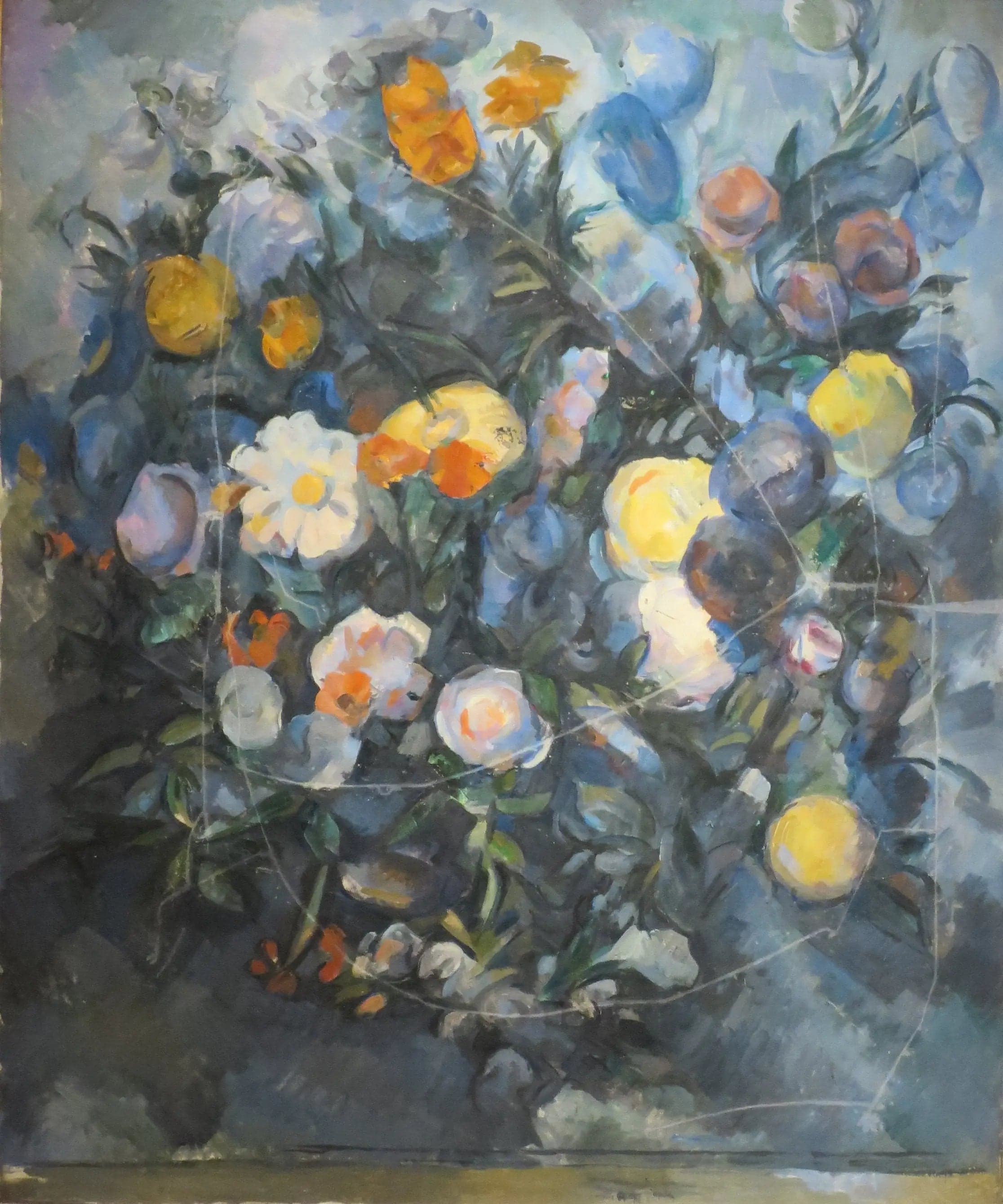
Bouquet of flowers, after Delacroix
- Original dimensions
- 64 x 77 cm
- Museum
- Pushkin State Museum of Fine Arts
- Year
- 1902
Scene depicted
This iconic painting highlights the delicate harmony of flowers, their ephemeral grace captured on the canvas with unmatched mastery. The hues intertwine, creating an expressive visual ballet, where light dances on each petal, revealing a living, vibrant nature rich in emotions. The work celebrates the beauty of bouquets, a tribute to the simplicity of the things that surround us.
Historical context
Created in 1902, this painting is set against a vibrant artistic context of the late 19th century, in Paris, a leading city of Impressionist and Post-Impressionist movements. The painting is now displayed at the Pushkin State Museum of Fine Arts in Russia, a prestigious setting for this canvas vibrant with colors and emotions. With its generous dimensions of 64 x 77 cm, Bouquet of Flowers transports us into Cézanne's flourishing universe.
Place in the artist's career
Bouquet of Flowers represents a turning point in Cézanne's career. A stylistic peak, where he echoes previous works like “The Large Bathers” and “Mont Sainte-Victoire.” While these paintings explore geometric structures, “Bouquet of Flowers” testifies to an emotional maturity, advocating for the liveliness of colors and a quest for sensory truth.
Anecdote
“Nature has infinitely much to offer us, it is enough to have the eyes to see.” These words, spoken by Cézanne, resonate powerfully when observing his masterpiece . Imagine him, one spring morning, walking through the gardens of Provence, where each petal, each scent stands out as a source of inspiration, thus awakening the evocative power of Bouquet of Flowers .