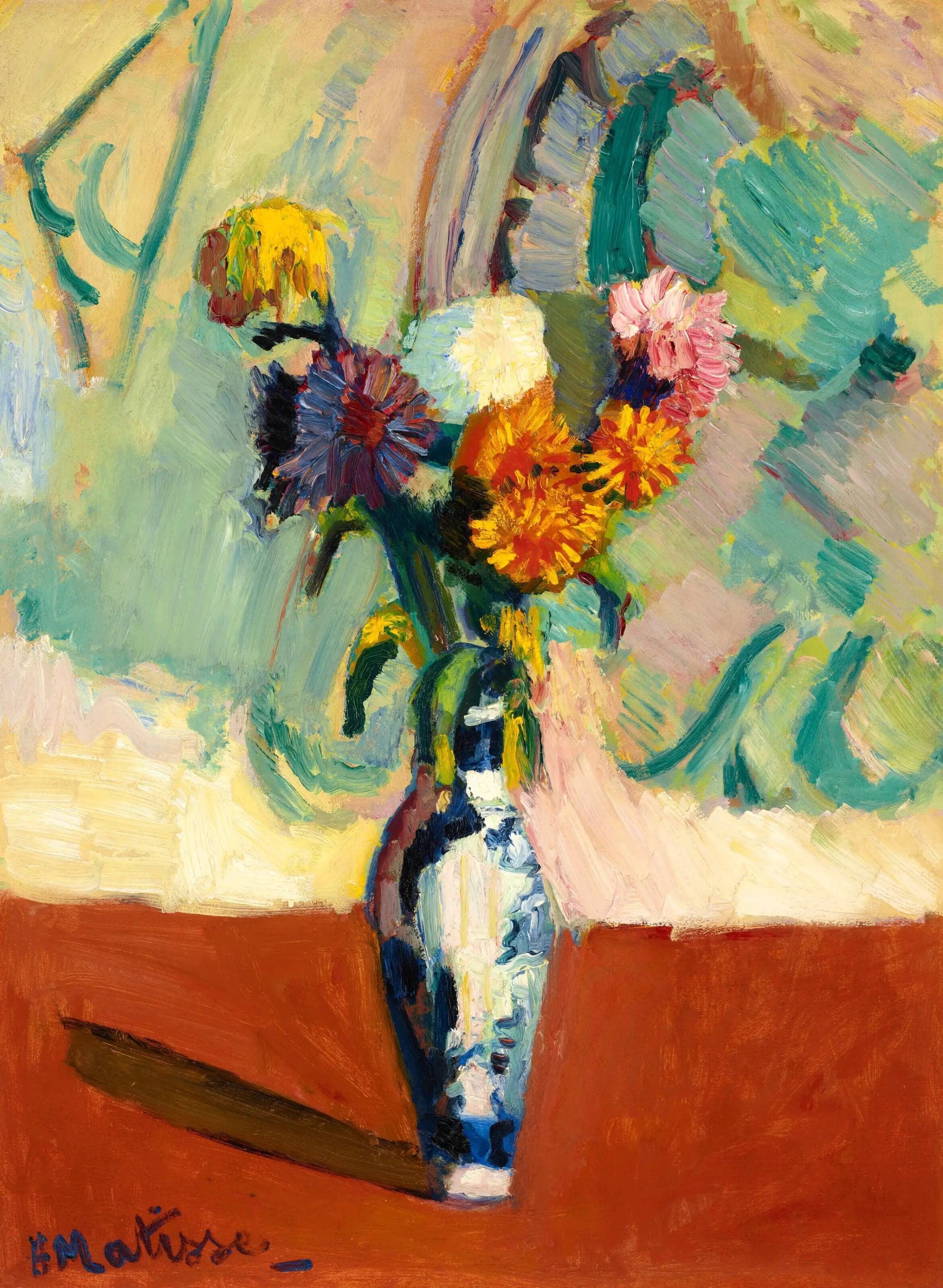
Bouquet, Chinese vase
- Original dimensions
- 53.8 x 72.5 cm
- Museum
- Not specified
- Year
- 1901
Scene depicted
The painting “Bouquet, vase chinois” is an ode to nature and harmony. Matisse takes ownership of the ceramic vase, a wonderful witness to Asian craftsmanship, and fills it with vibrant flowers. Each shade of color, each movement of flower is designed to capture the eye and the soul, transforming this composition into a burst of joy and vitality, like a celebration of the small wonders of life.
Historical context
Created in 1901, in the vibrant city of Paris, this pictorial work is set against a rich and tumultuous context of modern art. In the midst of the Fauvism movement, Matisse, with his bold palette and simplified forms, paves the way for a new way of perceiving nature. This painting is not only a reflection of the artistic trends of its time; it also embodies the energy of a bustling Paris, where the ideals of a new art are formed and asserted.
Place in the artist's career
“Bouquet, vase chinois” marks a higher step in Matisse's career, a moment when his style refines. Compared to other paintings such as “La Desserte” and “Femme au Chapeau,” a marked evolution is observed, where the artist oscillates between chromatic boldness and finesse of execution. This painting is a milestone, revealing the turning point of his journey towards liberated abstraction.
Anecdote
“Color is a kind of song,” said Matisse, a phrase that resonates powerfully in this masterpiece . Imagine a spring morning, the sun filtering through the shutters of a Parisian studio, Matisse, brushes in hand, drawing inspiration from freshly picked flowers, immersing himself in the bright bursts of the Chinese vase. Each brushstroke allows him to translate this emotion into painting , merging it with the light and the sweet scent of the flowers.