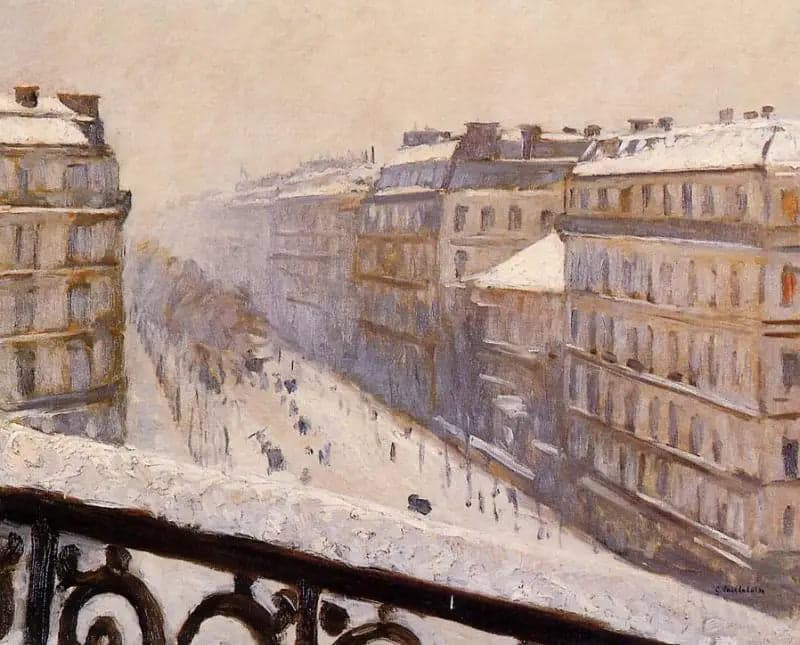
Boulevard Haussmann, snow effect
- Original dimensions
- 82 x 65 cm
- Museum
- Not specified
Scene depicted
This canvas immerses us in an urban scene where the effect of snow transfigures the everyday. The grand boulevards of Paris, usually bustling with life, seem here to be asleep. The light, soft and diffuse, reflects a romantic landscape where the silhouettes of passersby fade while mingling with the swirling snowflakes. Every detail, every nuance of shadow and light, contributes to the harmony of this poetic composition, embellishing a fleeting moment of Parisian life.
Historical context
This painting is emblematic and was created in 1880, in Paris, in the heart of the Île-de-France region. Inscribed in the Impressionist movement, it boldly reflects the urban landscape of the time, marked by modernity and social transformations. The canvas , although illustrious, remains outside museum institutions to this day, testifying to a time when the canvas captured vibrant fragments of life.
Place in the artist's career
Boulevard Haussmann, Snow Effect is part of a mature period of the artist, echoing other canvases such as The Floor Scrapers and The Beach at Trouville . This masterpiece represents a perfect synthesis of his ability to capture modernity while remaining true to his Impressionist roots. The technical and emotional evolution, visible through these works, testifies to his commitment to representing reality seen through an innovative prism.
Anecdote
“Snow transforms the streets into living paintings.” This imaginary quote resonates with the genesis of this masterpiece . Inspired by a morning when snow gently covered Paris, Caillebotte captured the ephemeral beauty of the moment, a meeting between nature and urbanity that haunts him throughout his creation. This fleeting passage crystallized on the canvas carries with it the scent of winter freshness, the delicate sound of footsteps on the frost.