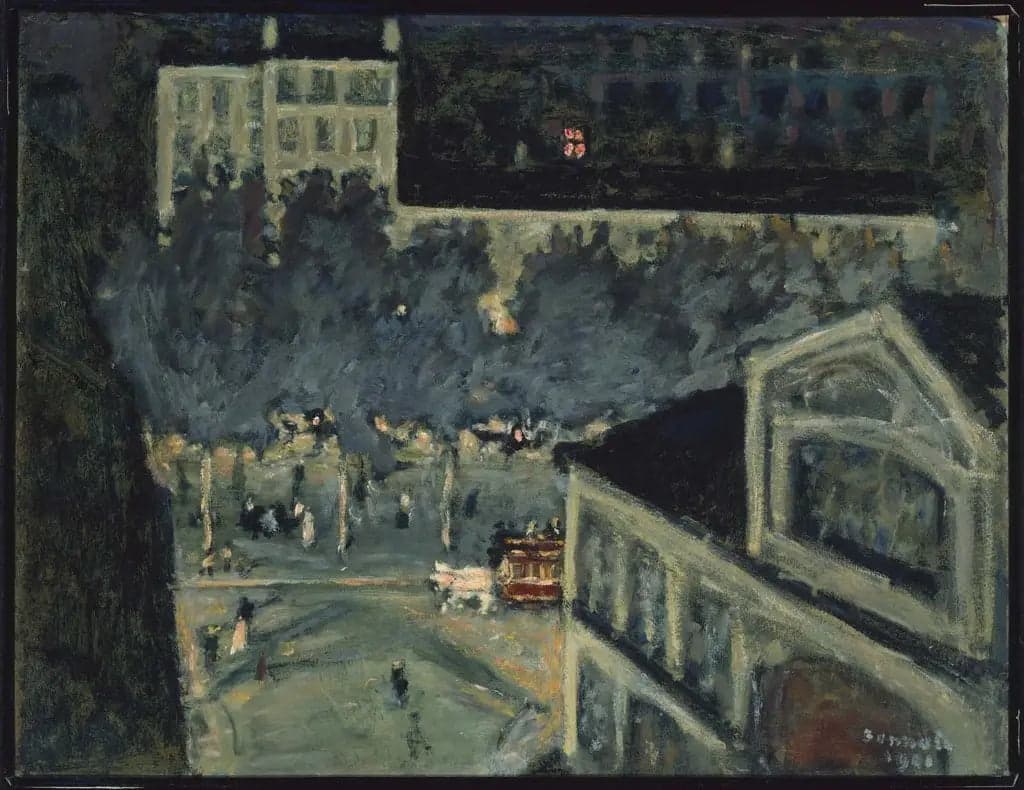
Boulevard de Paris at Night
- Original dimensions
- 58.1 x 45.1 cm
- Museum
- Museum of Fine Arts Boston
- Year
- 1900
Scene depicted
In the painting “Boulevard de Paris la nuit,” Bonnard invites us to dive into an animated and intimate scene. Passersby move under the glow of the street lamps, while the facades light up, bringing the observer closer to the warmth of human connection and the scent of Parisian cafés. It is a painting that tenderly celebrates the fleeting beauty of nighttime moments.
Historical context
Created in 1900, this painting is anchored in the vibrant heart of Paris, at a time when the Belle Époque illuminates the city. Pierre Bonnard , a pioneer of the Nabi movement, captures the essence of this era with a canvas vibrant with colors and lights. Today, the painting is preserved at the Museum of Fine Arts Boston , where it continues to amaze visitors.
Place in the artist's career
“Boulevard de Paris la nuit” represents a pivotal moment in Bonnard's career, marking both his liberation from academic traditions and the affirmation of his unique style. Compared to his works like “Le Nu bleu” and “Jardin à Vernon,” this canvas testifies to an evolution towards more intimate and vibrant compositions, where light and emotion intertwine.
Anecdote
“Art must speak of the simple joys of existence,” said Bonnard. The inspiration for this masterpiece came to him during a night walk through the streets of Paris, where the lights of the street lamps dance on the cobblestones, creating a poetic and enchanting atmosphere. This emotion is intensely found in the painting , which exudes the magic of Parisian life.