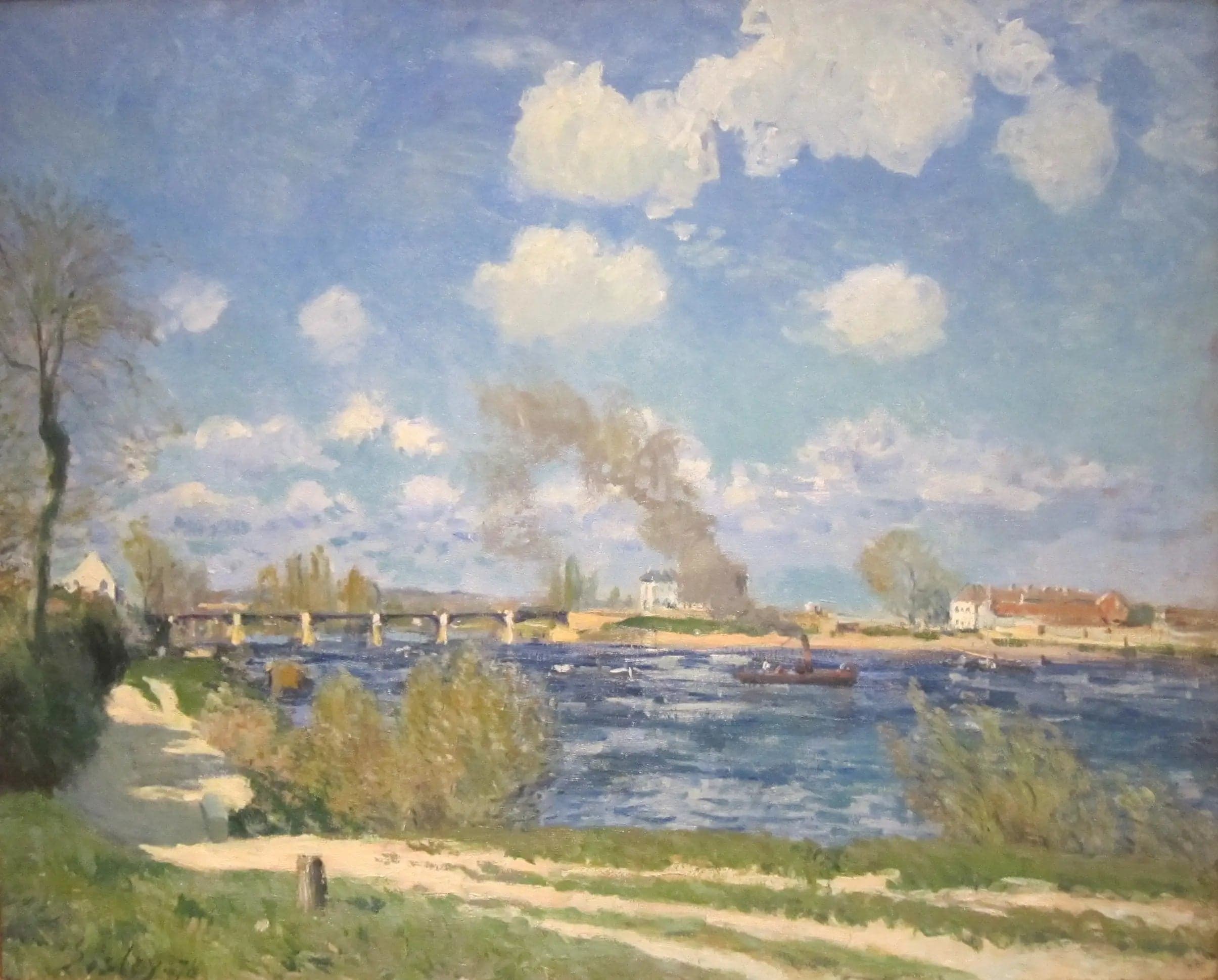
Bougival
- Original dimensions
- 73.7 x 62.2 cm
- Museum
- Cincinnati Art Museum
- Year
- 1876
Scene depicted
In the painting “Bougival,” Alfred Sisley captures a scene of daily life by the Seine. The shimmering reflections on the water, the sails of boats gliding gently, and the blurred silhouettes of bathers immerse the viewer in a peaceful and vibrant atmosphere. This painting is much more than a simple representation; it is a moment suspended in time, immortalizing the harmony between man and nature.
Historical context
Created in 1876, this painting is an iconic testament to the Impressionist movement, which was flourishing in Bougival, a charming village located on the banks of the Seine, not far from Paris. The canvas offers an intimate look at riverside life, evoking the sweetness of summer days. Currently housed at the Cincinnati Art Museum , this powerful work captures the essence of nature through Sisley's brush, whose mastery of color and light is truly remarkable.
Place in the artist's career
Positioning this painting as a significant milestone in the challenging career of Alfred Sisley , it marks a period when the artist, although still seeking recognition, begins to stand out for his fluid technique and unique sensitivity. Just a few years later, the painting “Impression, Sunrise” by Monet and “The Bridge at Argenteuil” also immerse us in this vibrant dialogue of colors, highlighting the stylistic evolution of Impressionism .
Anecdote
“Nature has always been my greatest inspiration, it whispers its secrets to those who take the time to listen.” Alfred Sisley might have said this while walking in the morning, the sweet scent of flowers floating in the air, encountering landscapes of stunning beauty that would nourish his work. Each brushstroke in Bougival reveals this intimacy with nature, a true visual poetry.