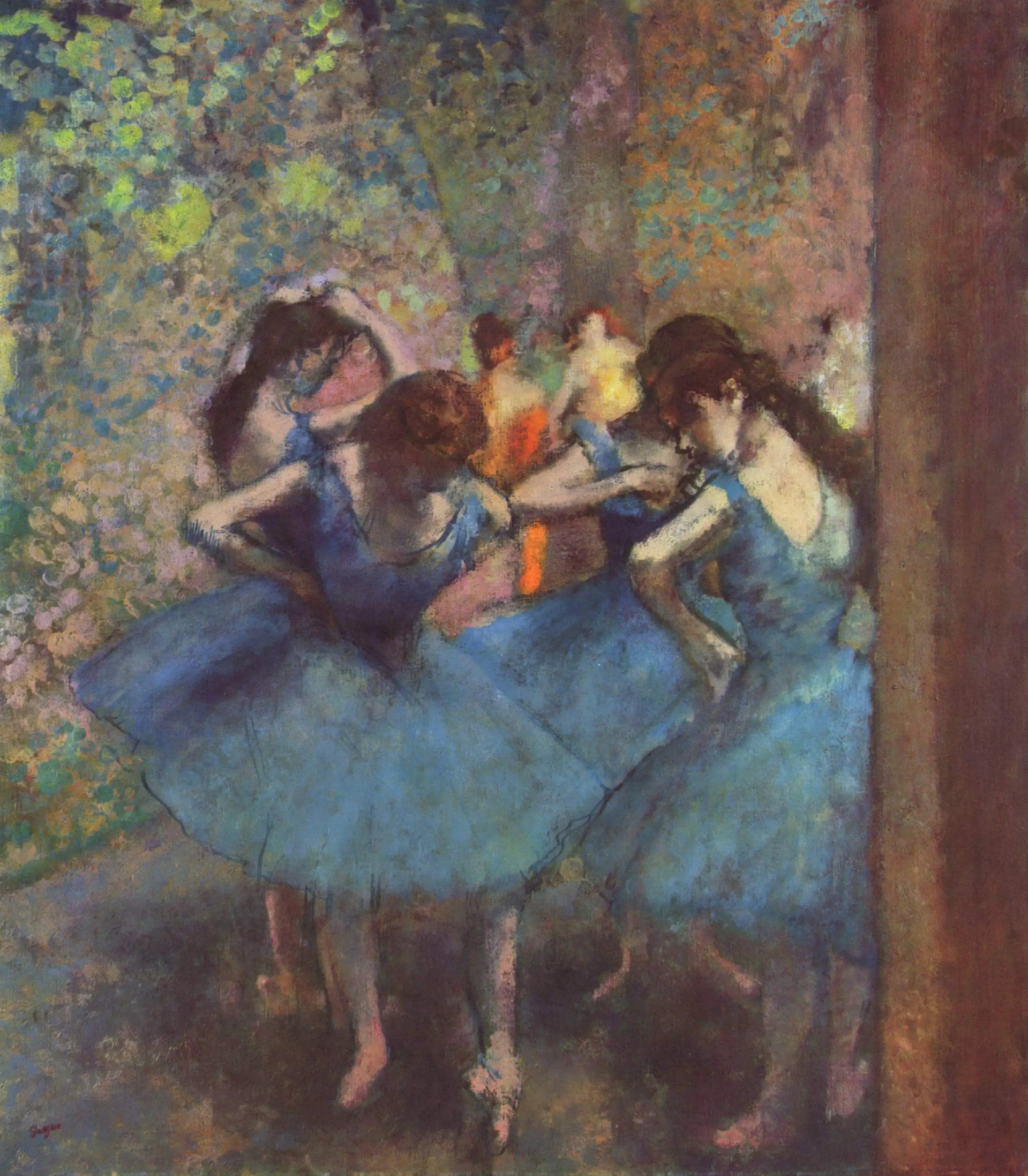
Blue Dancers
- Original dimensions
- 75.3 x 85.3 cm
- Museum
- Orsay Museum
- Year
- 1890
Scene depicted
In this pictorial work , Degas offers us a captivating glimpse into the world of classical dancers. The graceful figures leap in a harmony of fluid movements, their dresses full of life and their elegant posture adding a touch of poetry to the scene, elevating the painting to the rank of masterpiece. The blue, the dominant color, evokes both serenity and mystery, enveloping the dancers in a dreamlike aura.
Historical context
Created in 1890, in Paris, the painting emblematic Blue Dancers is part of the Impressionist movement, which revolutionizes the way to perceive light and movement. In this vibrant artistic context of the late 19th century, Edgar Degas immortalizes the grace of ballerinas within the Opera, a place that condenses the cultural effervescence of the city of light. Currently exhibited at the Orsay Museum , this canvas measures 75.3 x 85.3 cm, a size that gives it an unforgettable presence.
Place in the artist's career
Blue Dancers is situated at a key moment in Edgar Degas 's career, a period when his style reaches remarkable maturity. In parallel, his canvas The Dance Class and The Dancers at the Bar illustrate the different facets of his exploration of movement and light, marking the evolution of his technique. These compositions reveal Degas's passion for ballet, making this canvas a milestone in his celebration of dance.
Anecdote
Degas once declared: “Painting is a symbol of life.” Imagine him, one spring morning, sitting in the shade of an old oak, watching the dancers rehearse, their laughter and the rustling of tutus intertwining with the aromas of a flourishing Paris. In this painting , he captures not only a moment but a feeling, a grace, that resonates even today.