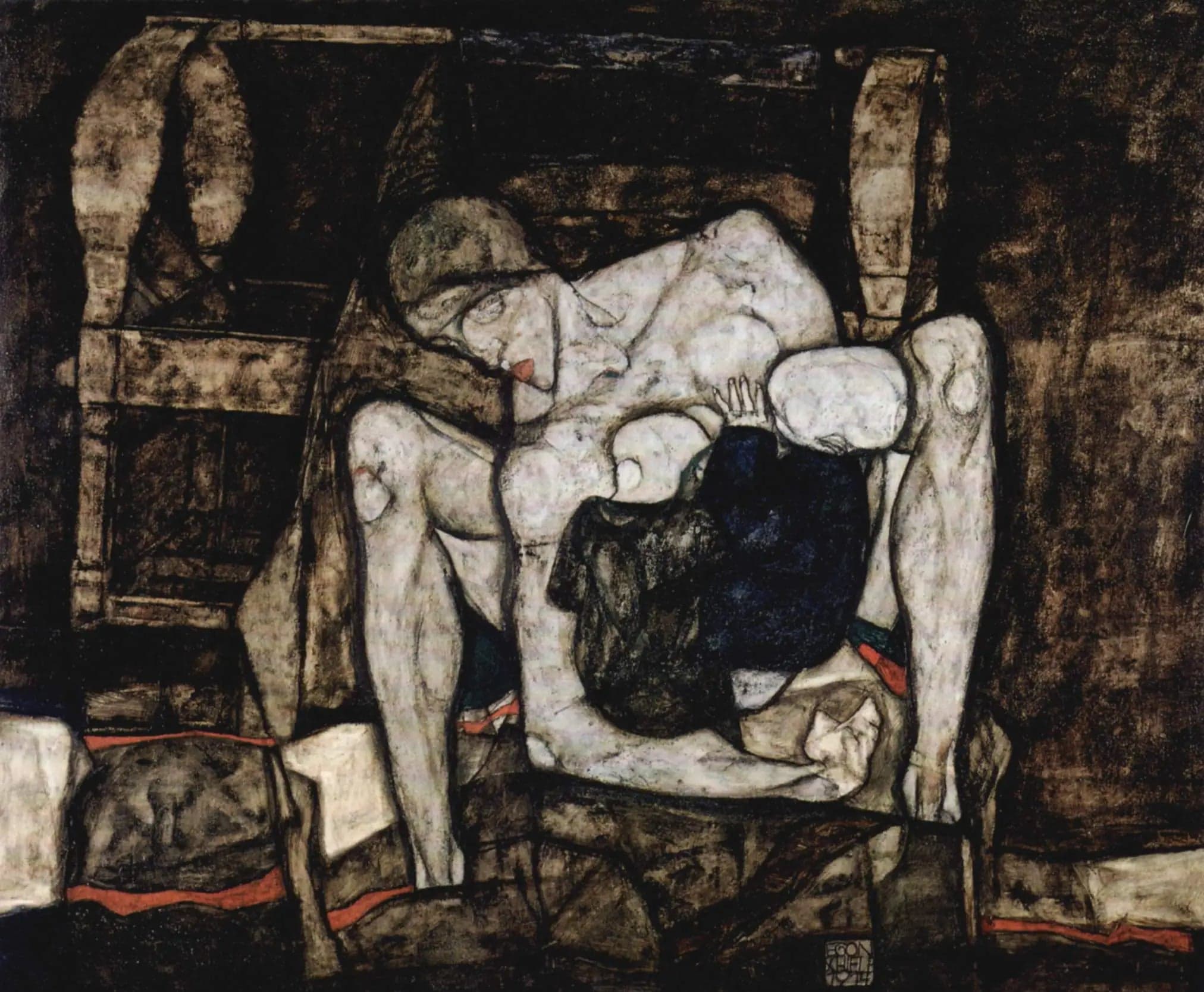
Blind Mother, or The Mother
- Original dimensions
- 120 x 99 cm
- Museum
- Not specified
- Year
- 1914
Scene depicted
The painting “Mère aveugle, ou La Mère” features a maternal figure embracing vulnerability, capturing a moment of poignant tenderness, where love and sorrow intertwine. It is an intense representation, which does not merely depict, but communicates the opposing emotions of loss and sacrifice, both intrinsic to the human condition.
Historical context
Created in 1914, in Vienna, this painting is part of the expressionist movement, characterized by a tumultuous exploration of human emotions. This era, marked by social and political upheavals, saw the emergence of many artists seeking to transcend reality. The canvas itself remains unknown, although its artistic legacy continues to inspire.
Place in the artist's career
This canvas represents a crucial step in Schiele's career. In his formative years, before reaching the stylistic peak of his expressionism , he created this masterpiece, alongside works like “The Family” and “Self-Portrait with Friend,” tracing an emotional evolution marked by increasing intensity.
Anecdote
“The mother is life, even when the light goes out.” These words from Egon Schiele evoke the deep emotion behind the genesis of this masterpiece . Perhaps it was a spring morning in the alleys of Vienna, where he encountered a maternal figure, whose shadow still dances in the memory of this canvas .