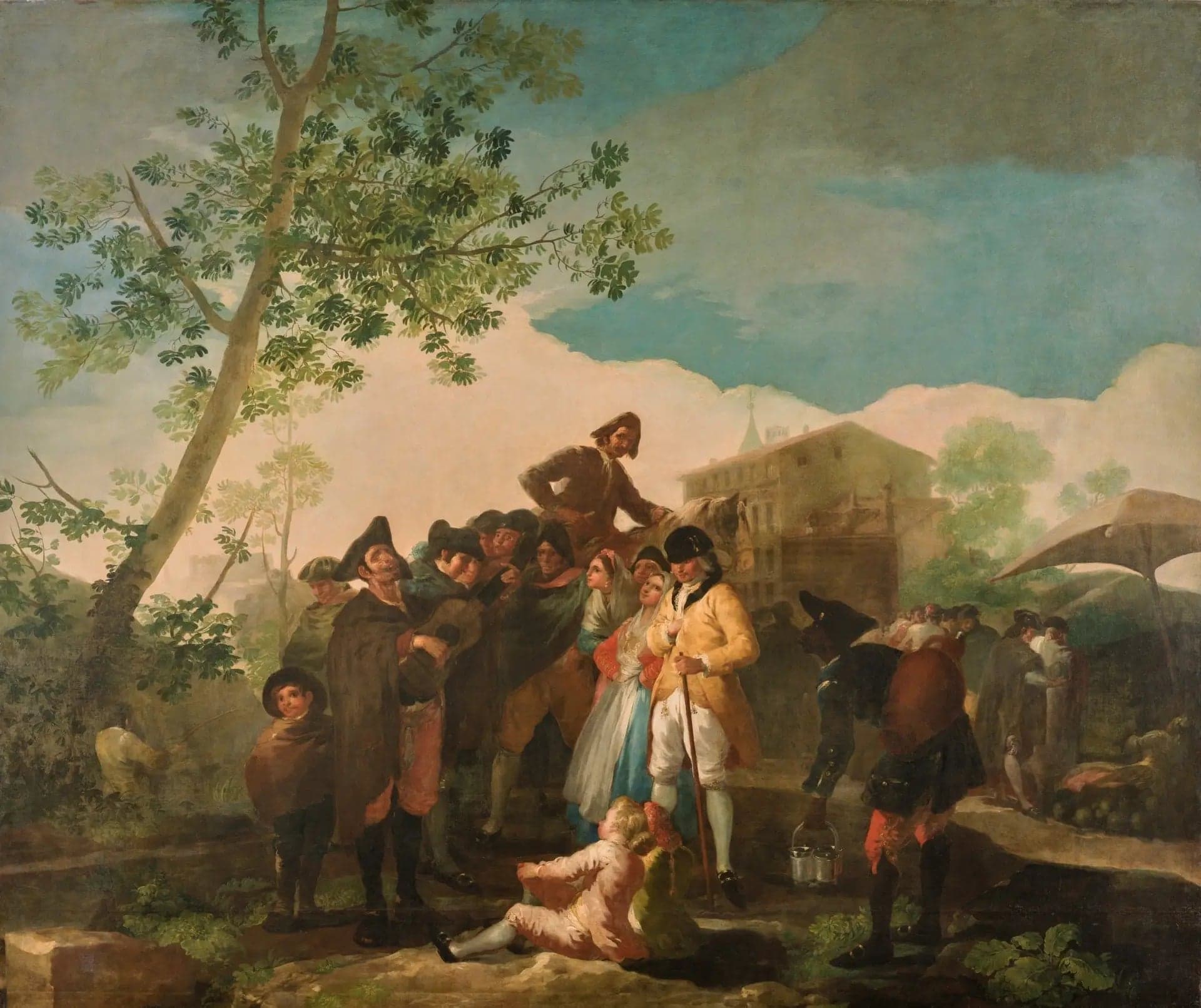
Blind Man with Guitar
- Original dimensions
- 311 x 260 cm
- Museum
- Prado Museum
- Year
- 1778
Scene depicted
“Blind Man with Guitar” features a blind musician sitting, eyes closed, lost in the melodies he draws from his instrument. His face, imbued with serenity, contrasts with the surrounding decor, creating an atmosphere of contemplation and introspection. This canvas illustrates the power of music, capable of elevating the spirit beyond physical limitations, awakening deep empathy in the observer.
Historical context
Created in 1778, in the vibrant city of Madrid, this pictorial work belongs to the emerging romanticism movement. At the heart of the Enlightenment period, this painting represents a changing France and Spain, where art begins to break free from conventions. Today, this canvas is housed in the Prado Museum, an iconic place that holds the treasures of the great Spanish artistic tradition.
Place in the artist's career
This canvas represents one of the highlights of Goya's career, a period when his style begins to evolve towards more poignant compositions. Alongside other paintings such as “The Clothed Maja” and “The Disasters of War,” this painting reflects his deep exploration of the human condition and its emotions.
Anecdote
“Art is the voice of the soul, and I always seek to hear it in silence.” Such could be Goya's words, evoking the inspiration behind this masterpiece . On an enchanting morning, at the corner of a sunlit alley in Madrid, his gaze fell upon a blind musician, filling the air with moving notes. This fleeting encounter inspired him to create this painting , which resonates with echoes of humanity and emotion.