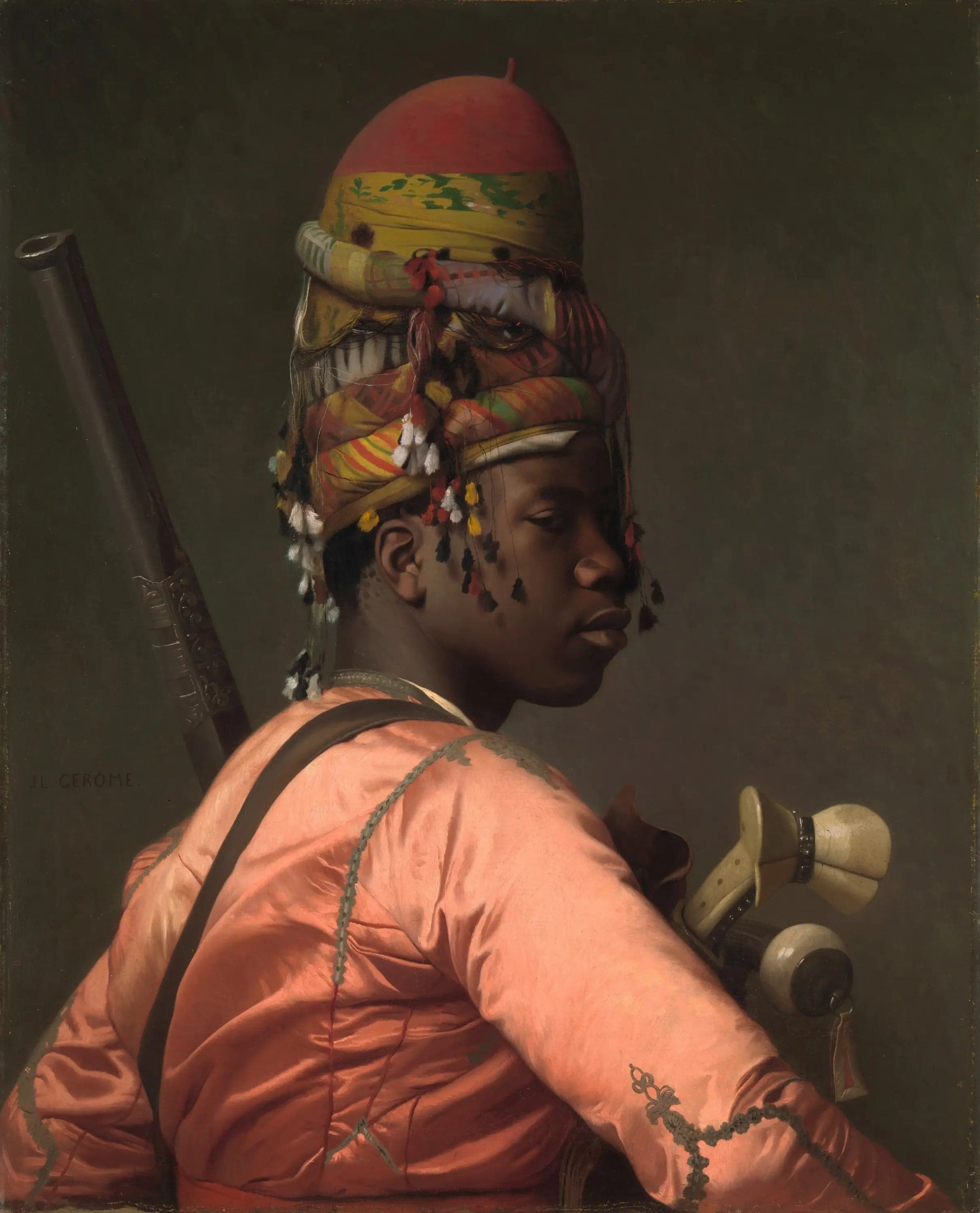
Black Bachi Bouzouk - Jean
- Original dimensions
- 66 x 80.6 cm
- Movement
- orientalism
- Museum
- Metropolitan Museum of Art
- Year
- 1869
Scene depicted
The painting “Bachi Bouzouk noir” depicts an elegant figure wrapped in a delicate turban, carrying a silent story. It is a fascinating portrait where the artist sublimates the subject, thus revealing a wealth of details and an unexpected psychological depth.
Historical context
Created in 1869, this painting emblematic finds its roots in the orientalism movement, an artistic current that celebrates the cultures and landscapes of the Arab world, notably through the virtuosic technique of Jean-Léon Gérôme . Today, the canvas proudly exhibits at the Metropolitan Museum of Art in New York, where it continues to amaze visitors with its majestic dimensions and narrative power.
Place in the artist's career
Situated at the peak of Gérôme's career, this painting marks a bold vision and a refined style, in parallel with other works such as “The Dance of the Almeh” and “The Market in Constantinople,” reflecting a stylistic evolution towards technical and narrative excellence.
Anecdote
Jean-Léon Gérôme once stated: “Art does not represent the world; it reveals it.” This phrase resonates poignantly in the masterpiece that is Bachi Bouzouk noir. Imagine the painter, on a spring morning, subtly capturing the golden light that bathed a lazy alley with his gaze, inspired by the beauty of the faces he encountered.
Major exhibitions
Fictions of Emancipation