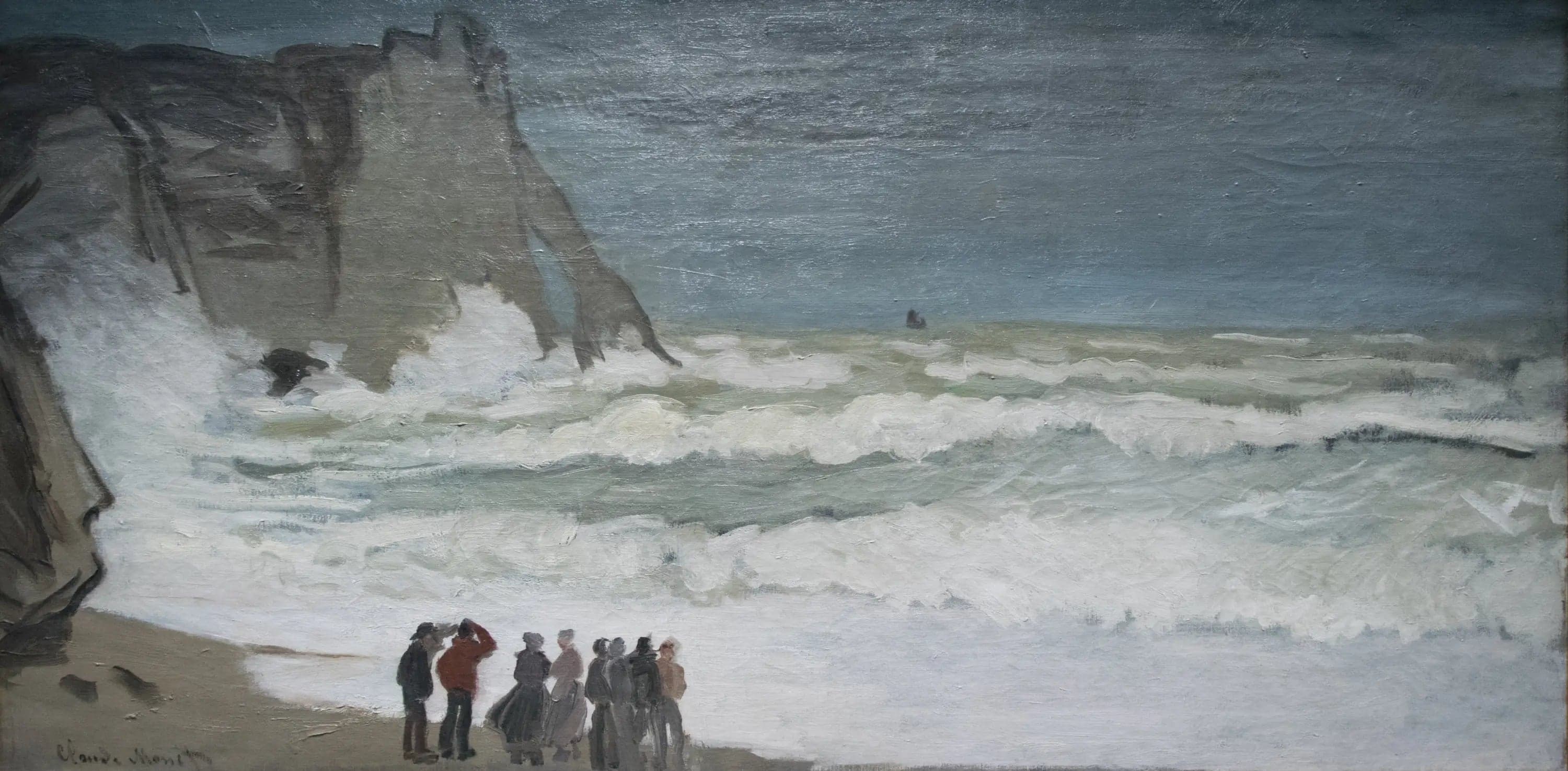
Big Sea at Étretat
- Original dimensions
- 130.5 x 66.2 cm
- Museum
- Orsay Museum
- Year
- 1868
Scene depicted
In the painting Rough Sea at Étretat , Monet immerses us in the heart of a tumultuous sea, where the waves crash forcefully against the majestic cliffs. The dynamic composition of this masterpiece conveys the struggle of natural elements, illustrating the symbiosis between land and sea that defines the Normandy landscape.
Historical context
Year: 1868 |BRK| Museum: Orsay Museum |BRK| Dimensions: 130.5 x 66.2 cm
Place in the artist's career
The painting Rough Sea at Étretat represents an important milestone in Monet's career, marking a period of stylistic maturity. In parallel with other paintings such as * Impression, Sunrise * and * The Water Lilies *, we see the evolution of light and color in his work, manifesting his relentless quest to capture the passage of time.
Anecdote
“The sea, in an instant, captures the light, the color, as well as the soul of a landscape.” It is with this thought that Monet captured the very essence of nature one vibrant morning. The inspiration for this painting was born during a walk on the beach, where the waves danced with the golden reflections of the sun, a scene that resonates powerfully through his canvas.