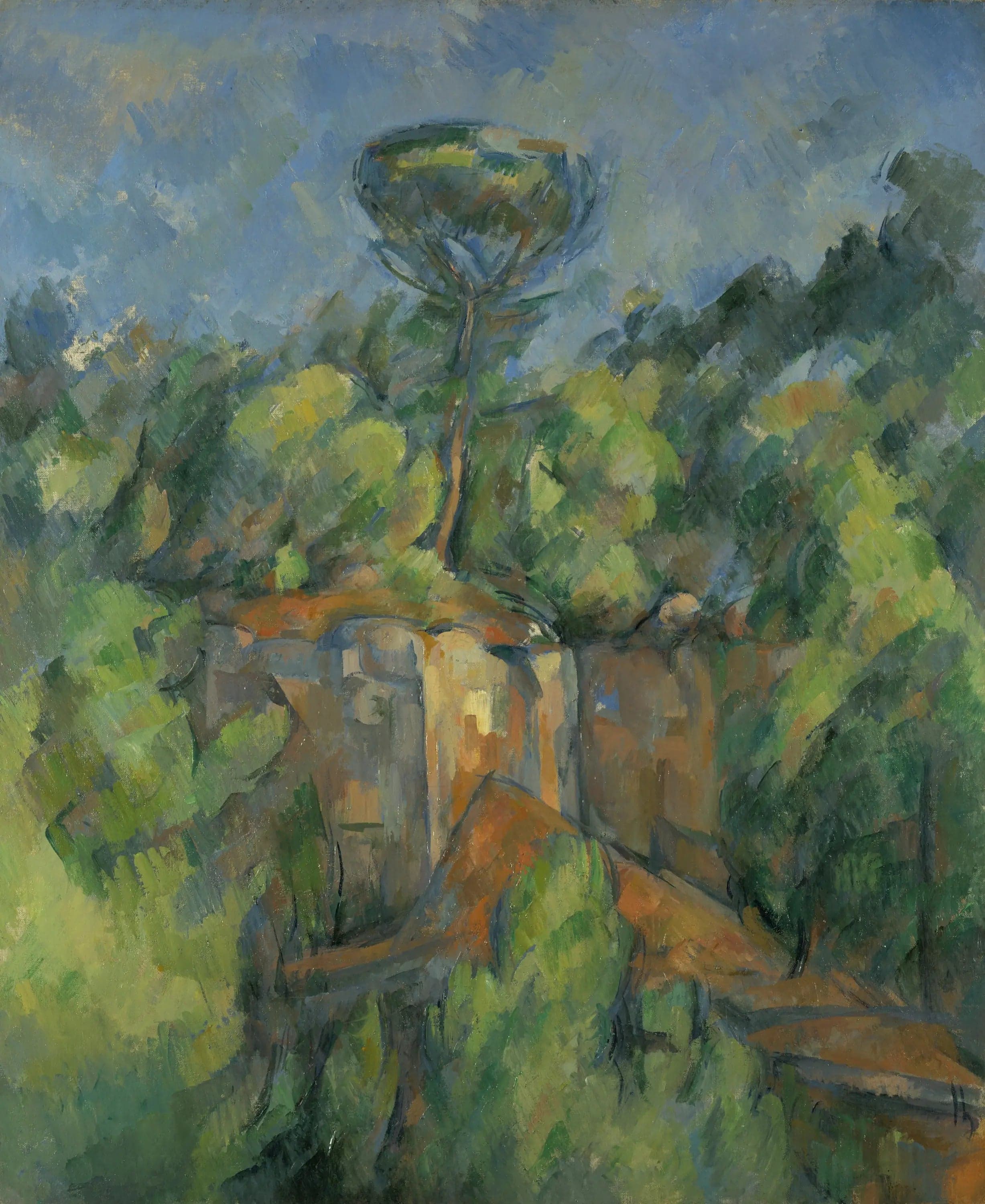
Bibémus Quarry
- Original dimensions
- 54.61 x 65.41 cm
- Museum
- Princeton University Art Museum
- Year
- 1897
Scene depicted
In this canvas , Cézanne immortalizes the famous site of Bibémus Quarry, a place rich in rocks and colors. One can discern the geometric shapes intertwining with the natural background. This painting depicts a landscape that seems to vibrate under the attentive and passionate gaze of the artist, a fusion between earth and soul.
Historical context
Created in 1897 in Aix-en-Provence, this painting echoes the Post-Impressionist influences, a period when Cézanne explores the richness of forms and colors. The painting is currently exhibited at the Princeton University Art Museum . The dimensions of this canvas reveal its visual impact, both in size and in its importance in the artistic landscape of the late 19th century.
Place in the artist's career
“Bibémus Quarry” represents a period of maturity in Cézanne's career, where he skillfully integrates elements from his previous paintings such as “The Montagne Sainte-Victoire” and “The Large Bathers.” One observes an evolution in his technique, moving from a more traditional approach to a bold and innovative composition , incorporating personal perspectives.
Anecdote
“I wish to render nature where I find it, without embellishment,” said Cézanne. It was one morning at Bibémus, surrounded by the melody of birds and the scent of pines, that he captured this incredible light, giving birth to his masterpiece . This painting thus becomes the vestige of pure inspiration, a reflection of vibrant nature.