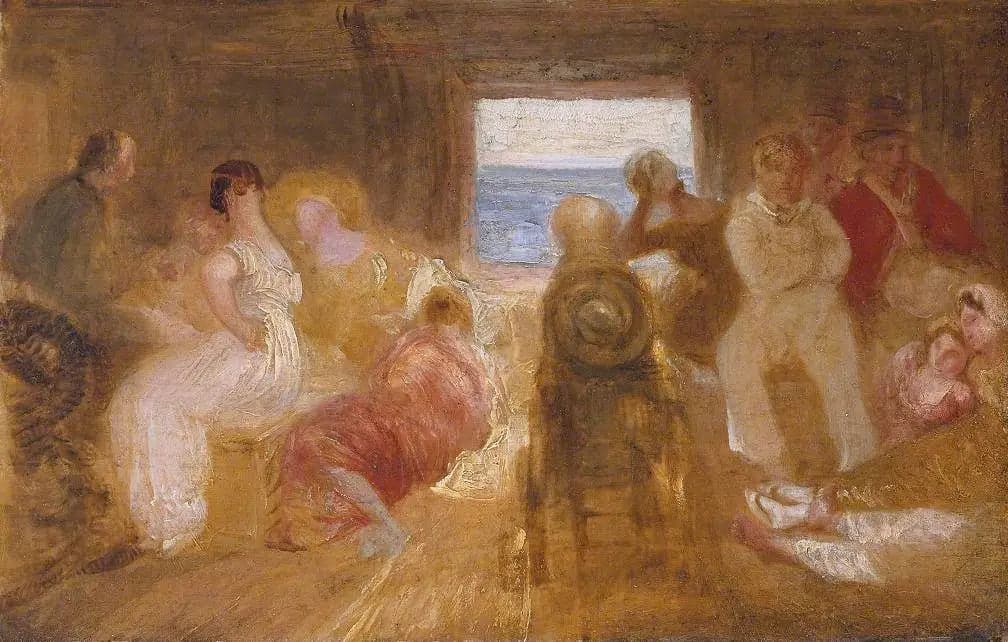
Between Decks
- Original dimensions
- 30.5 x 48.6 cm
- Museum
- Tate
- Year
- 1827
Scene depicted
The scene of Between Decks depicts the life of sailors on a ship, capturing the daily tumult of the sea and the freedom of a world in motion. Turner, through this pictorial work, immerses the viewer in the intimacy of a frozen moment, where faces communicate stories of hope, hard work, and camaraderie, thus abolishing time to celebrate maritime life.
Historical context
Created in 1827 in the heart of London, this iconic canvas by Joseph Mallord William Turner is part of the romantic movement, characterized by an exploration of human emotions and the wild nature. At that time, Turner, a pioneer of light on canvas, distinguished himself by his ability to capture maritime life with striking emotional intensity. The painting is currently on display at the Tate , a museum that honors the legacy of British art, and measures 30.5 x 48.6 cm.
Place in the artist's career
Between Decks is situated at a turning point in Turner's career, a revealing inflection point of his evolution towards expressive abstraction. Alongside The Fighting Temeraire and Rain, Steam and Speed , these paintings each embody, in their own way, his progressive exploration of light and atmospheres, placing Turner as a precursor of impressionism .
Anecdote
Turner, while contemplating the sea in a small harbor, reportedly declared: "Every moment captured by light is a living painting." It is this inspiring momentum that marks the conception of his masterpiece Between Decks . Navigating between calm and storm, the canvas evokes the human struggle against the force of the elements, infusing each brushstroke with vibrant energy.