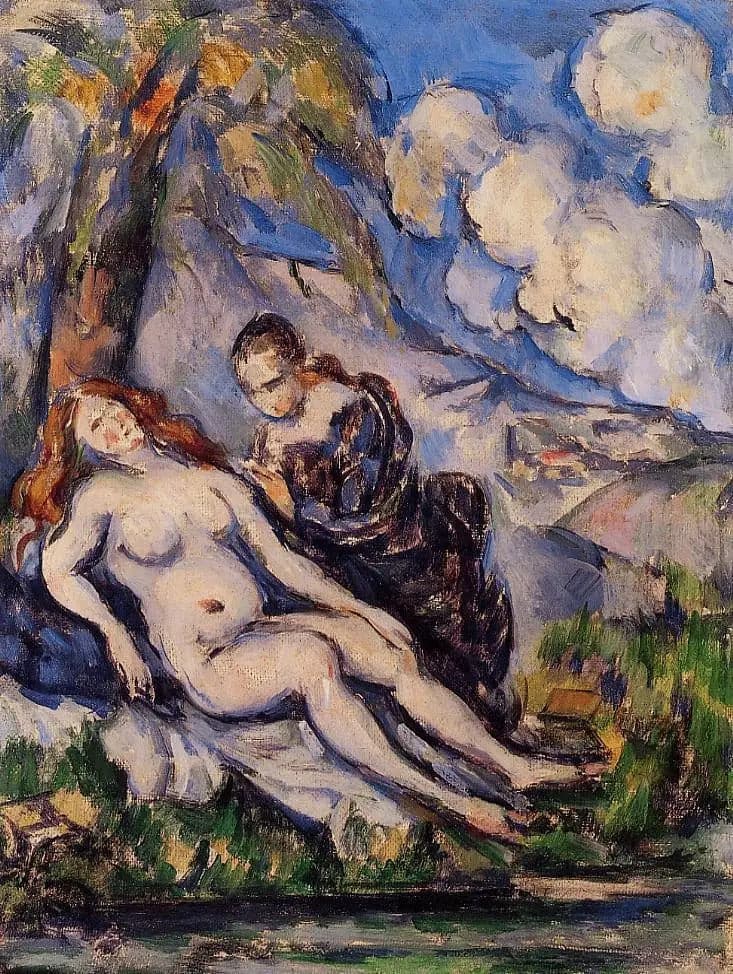
Bethsabée, or the Chaste Susanna
- Original dimensions
- 23.5 x 31.5 cm
- Museum
- Not specified
- Year
- 1885
Scene depicted
In this pictorial work , Cézanne transports us to an intimate moment, where Bathsheba is depicted in an atmosphere imbued with tension and beauty. The artist captures the sublime confrontation between innocence and desire, making this moment of pure emotion palpable through the meticulous strokes and rich colors of his canvas .
Historical context
Created in 1885, this painting emblematic of Paul Cézanne is rooted in the artistic context of the late 19th century, where the Impressionist movement begins to emerge. At that time, Cézanne, originally from Aix-en-Provence, redefines artistic vision through his innovative techniques. Although the original work is no longer displayed in a specific museum, its concise dimensions enhance the expressiveness of its canvas .
Place in the artist's career
Positioning this painting at the heart of his career, Cézanne asserts himself as a precursor of the modern language of painting . Alongside masterpieces such as The Card Players and Mont Sainte-Victoire , one perceives an evolution in his technique, where emotion and structure blend skillfully, thus affirming his unique style.
Anecdote
“Painting is an incessant search for truth,” said Cézanne. He often drew inspiration from his surroundings, particularly the dreary Provençal days. This painting is the result of a gentle morning where the sunlight played on the face of his model, revealing the contrast between purity and passion. This vibrant element is found in the evocative strength of Bathsheba, or the Chaste Suzanne .