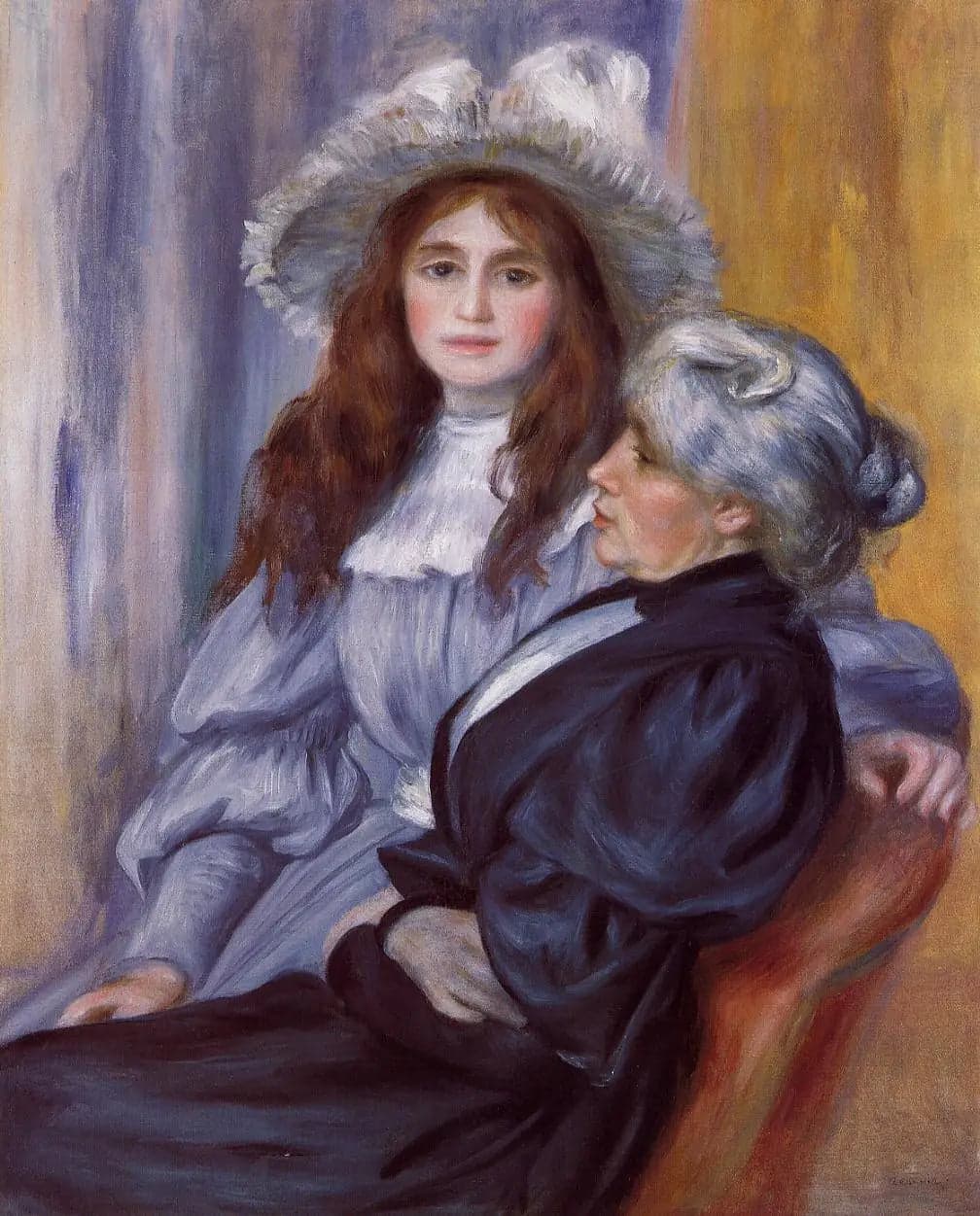
Berthe Morisot and her daughter Julie Manet - Pierre
- Original dimensions
- 65.5 x 81 cm
- Museum
- Not specified
- Year
- 1894
Scene depicted
The painting “Berthe Morisot and her daughter Julie Manet” captures a poignant scene of intimacy between mother and daughter. Renoir, master of the Impressionist portrait, immortalizes this sweet moment where psychology and tenderness intertwine under the golden light, creating a pictorial work that seems pulsated by life, the sweetness of maternal love, and the innocence of childhood.
Historical context
Created in 1894, this painting takes place within the Impressionist movement, which emerged in Paris, France, in the second half of the 19th century. At that time, visionary artists like Renoir captured the very essence of life, with a unique perspective on the immediacy and fleeting beauty of everyday scenes. Although its current location is not specified, this iconic canvas continues to be admired for its emotional depth and brilliance.
Place in the artist's career
This painting marks a period of maturity in Renoir's career, a moment when he distances himself from academic conventions to better explore light and color. Alongside other masterpieces such as “Luncheon of the Boating Party” and “Dance in the City,” this canvas reveals a technical and emotional evolution, representing the perfect fusion of realistic representation and Impressionist sensation.
Anecdote
“Every canvas is a chapter of our existence,” Renoir said. This quote resonates deeply as he brought his composition to life in a spring atmosphere, where the morning light dances on the radiant faces of Berthe Morisot and her daughter, Julie Manet. This precious moment, filled with maternal tenderness, becomes the beating heart of the painting .