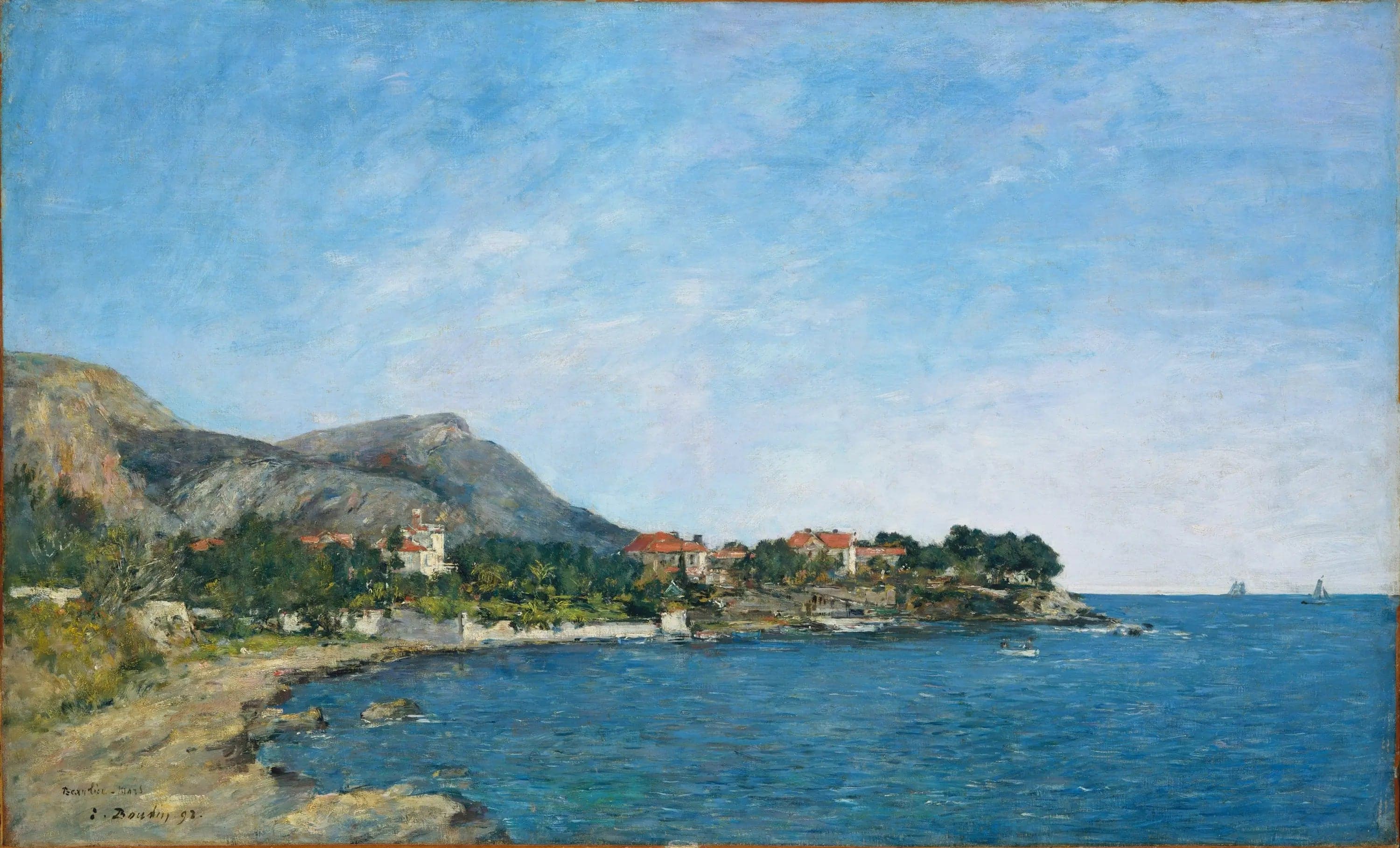
Beaulieu, The Bay of Ants
- Original dimensions
- 90.2 x 54.9 cm
- Museum
- Metropolitan Museum of Art
- Year
- 1892
Scene depicted
The painting “Beaulieu, The Bay of Ants” depicts an idyllic coastal scene, where the gentle reflections of the water dance with the light. The white sails of the boats blend with the azure hues of the sky, creating a harmony that invites contemplation. Boudin evokes here not only an image but an atmosphere, bathed in the serenity of a timeless place.
Historical context
Created in 1892, this painting timelessly finds its roots on the Côte d'Azur, in Beaulieu-sur-Mer. The work is part of the Impressionist movement, an artistic movement that evokes the capture of visual impressions, atmospheres, and lights. Currently exhibited at the Metropolitan Museum of Art , this canvas of 90.2 x 54.9 cm embodies the essence of Boudin's art, revealing the beauty of nature.
Place in the artist's career
This painting , both emblematic and representative of Boudin's artistic maturity, is situated at a turning point in his career. It highlights his affinity with maritime landscapes while connecting to other significant works like “The Beach of Trouville” and “The Port of Honfleur,” thus testifying to his technical and emotional evolution.
Anecdote
“Nature is my greatest teacher,” could have declared Eugène Boudin during his explorations by the sea. Inspired by the golden light of a spring morning over the Bay of Ants, he transported this vibrant emotion into his canvas , echoing his deep observations of nature.