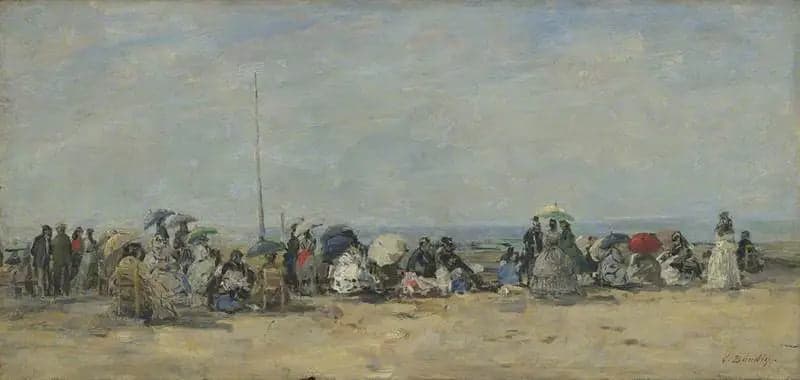
Beach Scene, Trouville
- Original dimensions
- 29.8 x 15.2 cm
- Museum
- National Gallery
- Year
- 1873
Historical context
Created in 1873, this painting is the result of the careful observation of Eugène Boudin in Trouville, a charming seaside resort on the Normandy coast. Immersed in the heart of the Impressionist movement, this canvas resonates with the spirit of the Belle Époque, a time when art began to capture light and atmospheres in an unprecedented way. The canvas currently resides at the National Gallery, bringing with it a part of the French artistic heritage.
Place in the artist's career
“Beach Scene, Trouville” marks a turning point in Boudin's career. As a pioneer of Impressionism , he explores here a lively fresco of light and movement, heralding the backdrop of a period where his other canvases such as “The Beach at Trouville” and “Woman on the Beach” testify to his ability to bring the moment to life. This canvas is situated in the heart of his artistic maturation period, where each work becomes a tribute to natural beauty.
Anecdote
“Nature is a poem that I try to translate into color.” These words of Eugène Boudin resonate particularly during the creation of his masterpiece . It was on the beach of Trouville, on a sunny morning, that the artist found inspiration, observing families delighting in the surf of the waves and the salty scent that floated in the air. Each brushstroke of the painting evokes these moments of shared serenity.