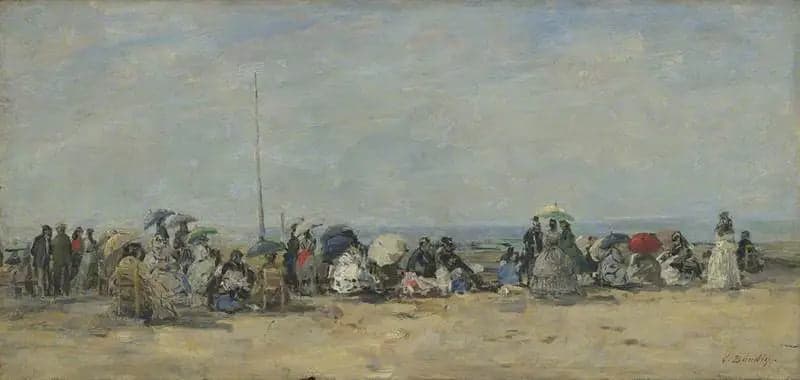
Beach Scene, Trouville
- Original dimensions
- 45.8 x 21.6 cm
- Museum
- National Gallery
- Year
- 1865
Historical context
Created in 1865, on the shores of Normandy, the painting "Beach Scene, Trouville" is part of the Impressionist movement that was emerging in France at the time. This iconic work by Eugène Boudin captures the essence of seaside life in Trouville, a resort favored by the aristocracy of the era. Currently, this painting is housed in the National Gallery, where it continues to dazzle visitors with its freshness and enchanting atmosphere.
Place in the artist's career
This painting represents a pivotal moment in Eugène Boudin 's career, marking his transition to stylistic maturity. Compared to "The Port of Trouville" and "The Beach of Deauville," it demonstrates his technical evolution: from figurative realism to a more free and expressive approach, foreshadowing the Impressionism that would emerge a few years later.
Anecdote
Eugène Boudin once stated: "Painting is found in light, and light is all around us." It was while strolling along the beach one spring morning that he captured the inspiration for this masterpiece . The softness of the whispers of the waves, the smell of salt and seaweed mixed with the gentle breeze illuminate this canvas , providing a sense of escape.