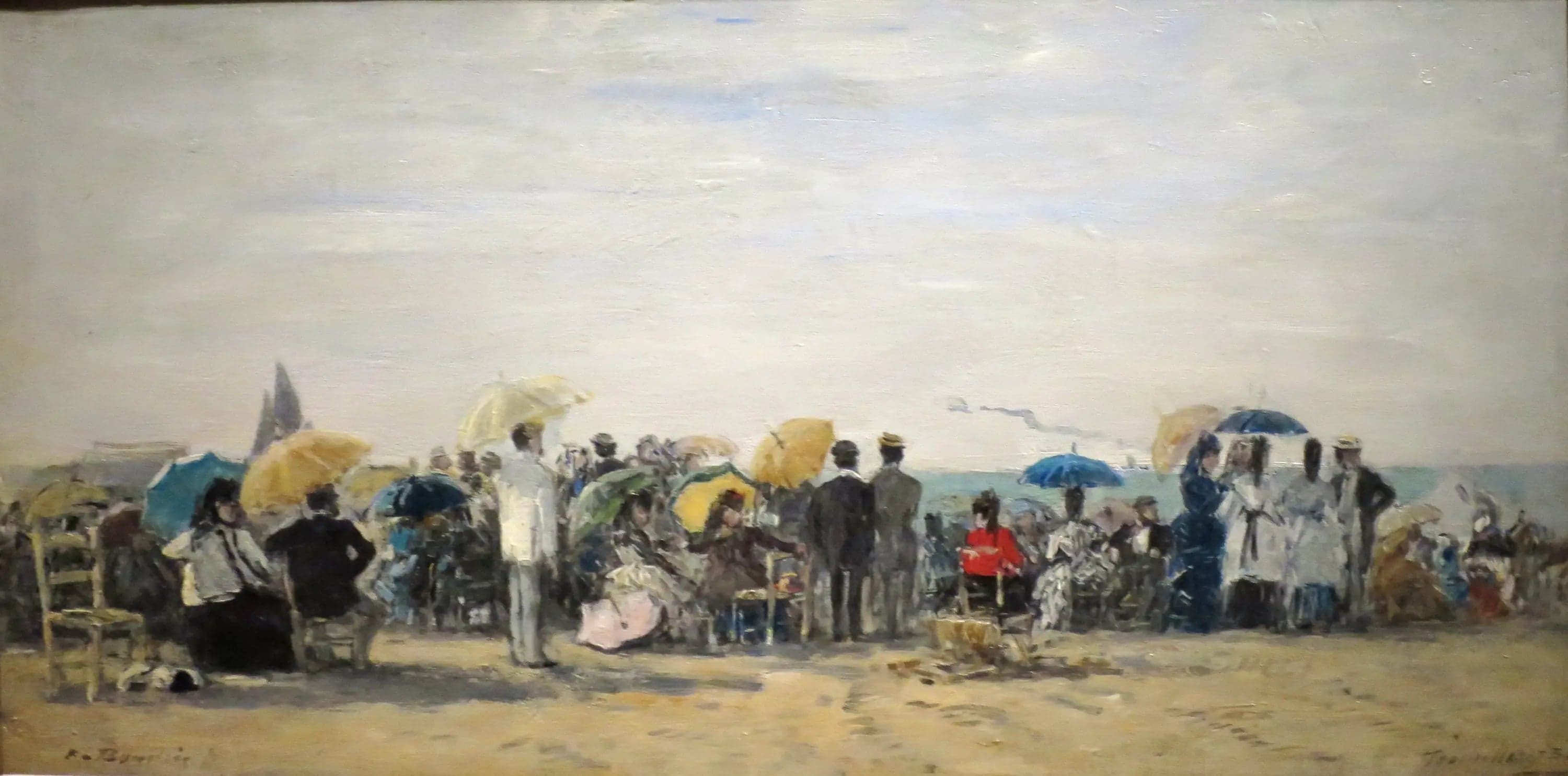
Beach at Trouville
- Original dimensions
- 41.3 x 21 cm
- Museum
- Norton Simon Museum
- Year
- 1873
Scene depicted
In this canvas , Eugène Boudin immerses us in the heart of a lively beach scene, where bathers of the time flourish in the waves. Under a bright sky, the sea stretches as far as the eye can see, caressing the fine sand and inviting daydreaming. The rosy cheeks of children and the melodious laughter of families blend with the lightness of the white sails of boats, creating an atmosphere of escape and freedom.
Historical context
Created in 1873, in the picturesque coastal town of Trouville-sur-Mer, this painting is at the heart of the Impressionist movement, foreshadowing the great artistic upheavals of the late 19th century. Within a setting dedicated to the light and shadow of the Norman shores, Boudin's canvas is now part of the exceptional collections of the Norton Simon Museum , offering visitors a window into its original brilliance.
Place in the artist's career
This painting , a true pivot in the artistic evolution of Eugène Boudin , marks the transition to a poetics of light. Alongside his other masterpieces, such as “The Beach at Trouville” and “Women by the Sea,” it testifies to his ambition to capture every nuance of nature, revealing a progression towards a more vibrant color palette and heightened sensitivity.
Anecdote
“The sea is always in motion, it whispers a melody that only artists can capture,” Boudin might have said during his escapades on the beach. The inspiration for this pictorial work , captured by a gentle breath and the murmur of a peaceful ocean, is felt in every brushstroke, embodying the magic of a fleeting moment, like a waking under the rising sun.