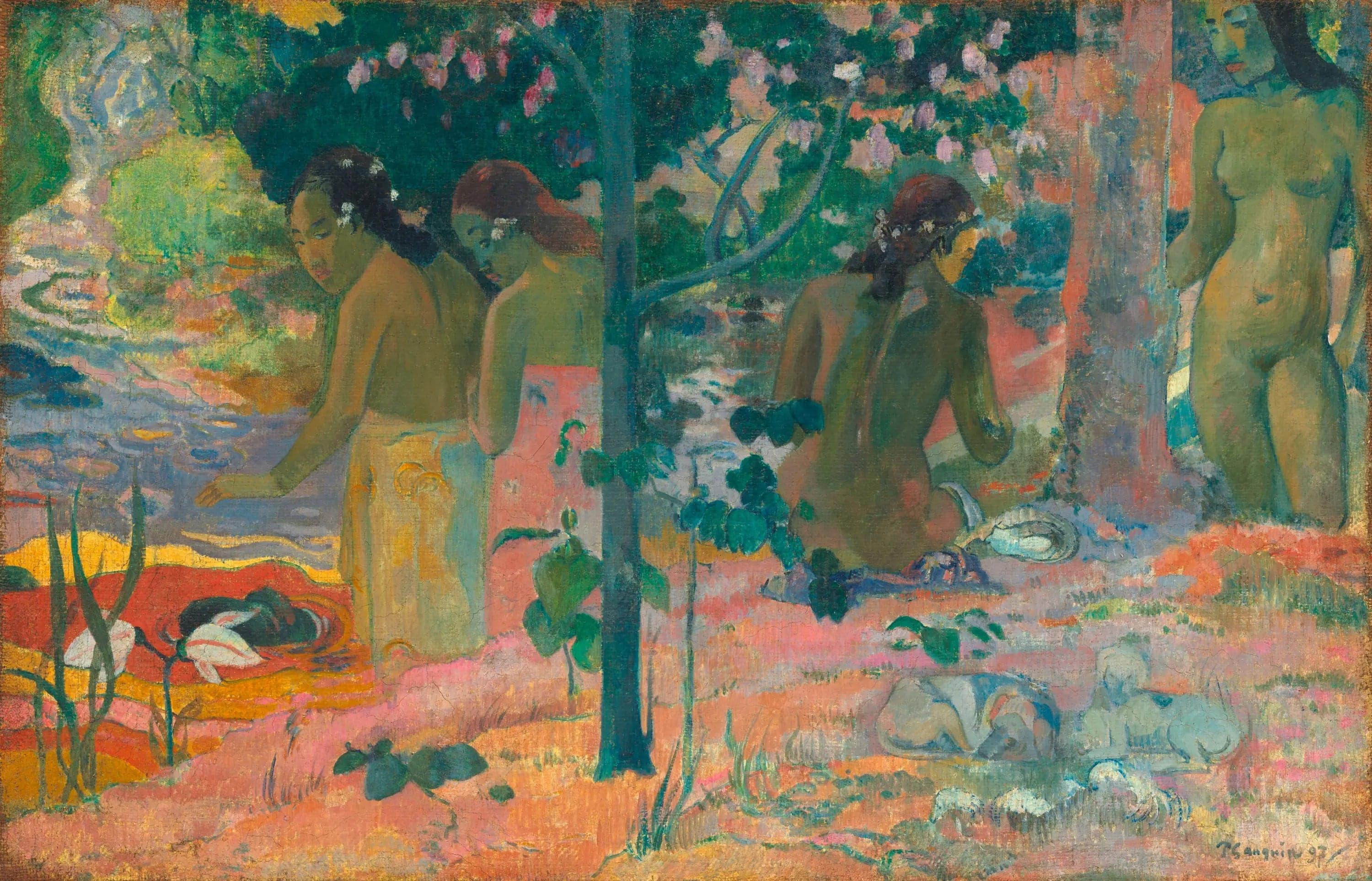
Bathers
- Original dimensions
- 93.4 x 60.4 cm
- Museum
- National Gallery of Art
- Year
- 1897
Scene depicted
The painting “Bathers” depicts a poetic moment where delicately sketched female figures flourish in a vibrant natural setting. The bathers, in a dance of colors, evoke both the serenity and sensuality of an era where time lingers, as a tribute to the wild beauty of nature flirting with Polynesian culture.
Historical context
Created in 1897, this painting emblematic of Paul Gauguin is the result of a period rich in creativity where the artist, attached to his Polynesian roots, developed an innovative style stemming from the post-impressionist movement. The painting is currently located at the National Gallery of Art , a sanctuary of artistic curiosities, where it shines through its harmonious dimensions.
Place in the artist's career
“Bathers” represents a turning point in Gauguin's career, the synthesis of an exuberant style characterized by bold lighting and stylized forms. It is situated between paintings such as “Vision after the Sermon” and “The earthly paradise,” showing a marked evolution towards aesthetic and emotional escape, thus proving his desire to transcend everyday reality.
Anecdote
“In every canvas, I seek to capture the soul of the moment,” said Gauguin. The inspiration for this masterpiece may have emerged one golden morning, under the gentle murmur of the waves of Tahiti, when the rays of sunlight play on the moving bodies of the bathers, transforming them into silhouettes of light. This painting thus becomes the memory of a suspended moment.