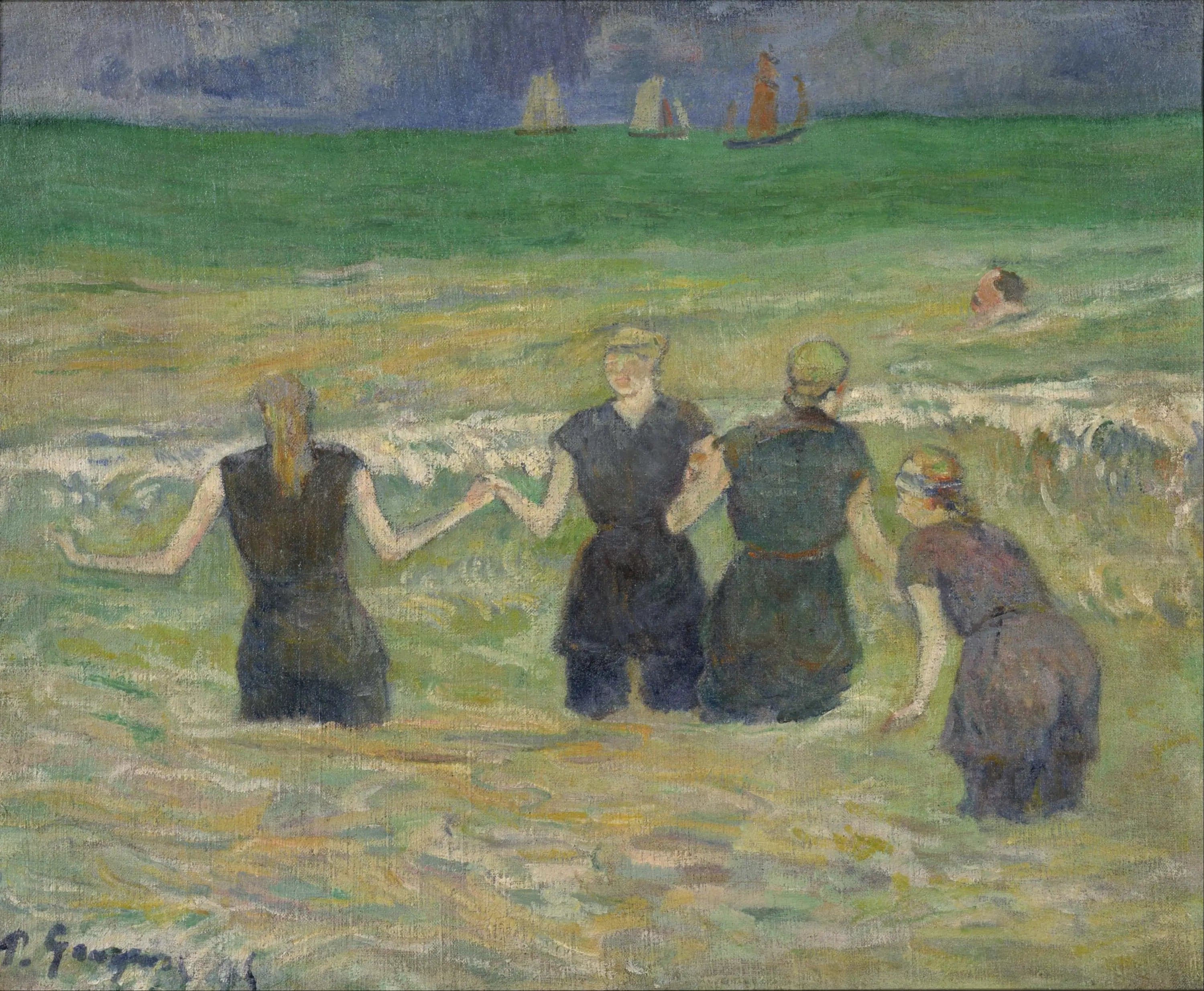
Bathers at Dieppe
- Original dimensions
- 462 x 381 cm
- Museum
- National Museum of Western Art
- Year
- 1885
Scene depicted
In this canvas , the bathers are frozen in a suspended moment, their bodies blending with the gentle whispers of the waves. The forms are enveloped in a delicate blur, a testament to a moment of intimacy between nature and human life. The sky of a brilliant blue and the radiant light provide a backdrop for this painting imbued with peace and freedom.
Historical context
Created in 1885 in Dieppe, this painting is part of the post-impressionist movement. Paul Gauguin , in search of a new palette, captures in this canvas the spring atmosphere of the Normandy coast, where the bright sky mingles with the azure sea. Currently housed in the National Museum of Western Art , this canvas of imposing dimensions (462 x 381 cm) invites the viewer to immerse themselves in a world where nature and humanity coexist harmoniously.
Place in the artist's career
The painting "Bathers in Dieppe" marks a crucial step in Gauguin's career, establishing a bridge between his impressionist beginnings and his quest for a more symbolic abstraction. During this period, he also creates other canvases such as "Vision after the Sermon" and "The Yellow Christ," which reflect a notable evolution in his pictorial language.
Anecdote
“The light of the sea inspires me more than anyone.” In the beautiful light of a morning, on the beach of Dieppe, Gauguin carefully observes the silhouettes of women enjoying the lively water. This moment of wonder becomes the fertile source of his masterpiece , capturing the joy and serenity of the bathers.