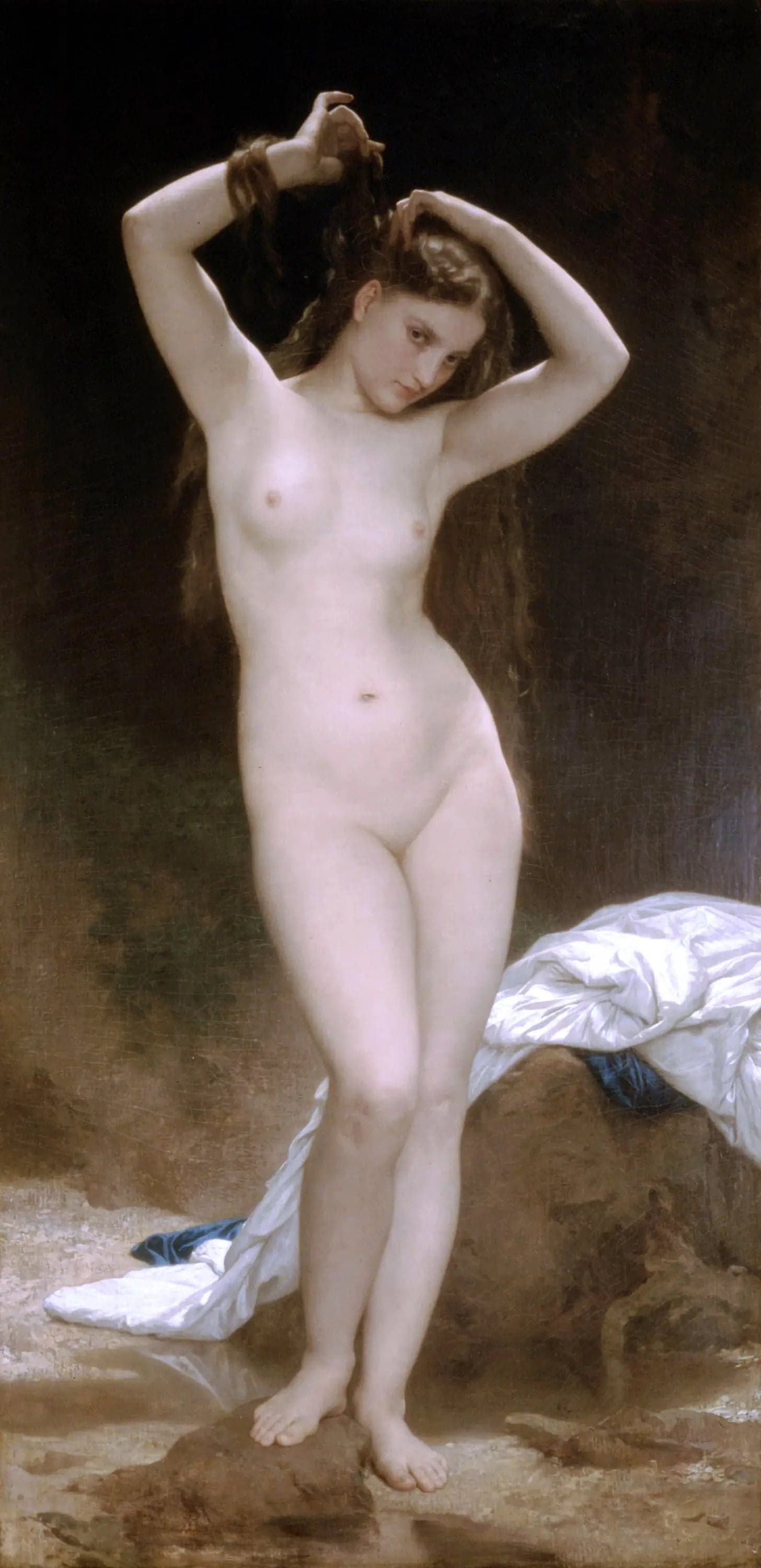
Bather
- Original dimensions
- 95 x 190 cm
- Movement
- academicism
- Museum
- Not specified
- Year
- 1870
Scene depicted
On this canvas , a woman is depicted at the water's edge, between shadow and light. Her fluid movements evoke a natural purity, as she dips her feet into the cool wave. The reflections on the water, the light caressing the skin, and the whispering ripples create a delicate atmosphere where every gaze gets lost in the intimacy of a suspended moment. The scene is alive, speaking to the senses as much as to the soul.
Historical context
Created in 1870, in the artistic city of Paris, this painting is part of the academic movement, reflecting a time when art aimed to be classical and rigorous. The canvas , now preserved in a private collection, celebrates the timeless beauty of the feminine form, while revealing Bouguereau's technical know-how. The richness of emotions, the clarity of details, and the delicacy of poses are the result of meticulous work.
Place in the artist's career
This painting , “Bather,” marks a turning point in Bouguereau's career, representing his stylistic peak. Associated with other works like “The Haymakers” and “The Nymph and the Satyr,” this composition illustrates the evolution of his approach towards more sensual and emotional themes, capturing the feminine essence with unparalleled depth.
Anecdote
“I paint a woman, the very essence of beauty and truth, for every brush stroke must tell her story.” These words of Bouguereau resonate strongly as one contemplates this pictorial work . The artist, on a sunny morning, finding inspiration in the laughter of children playing near a river, captured this fleeting moment in the painting that would become a masterpiece.