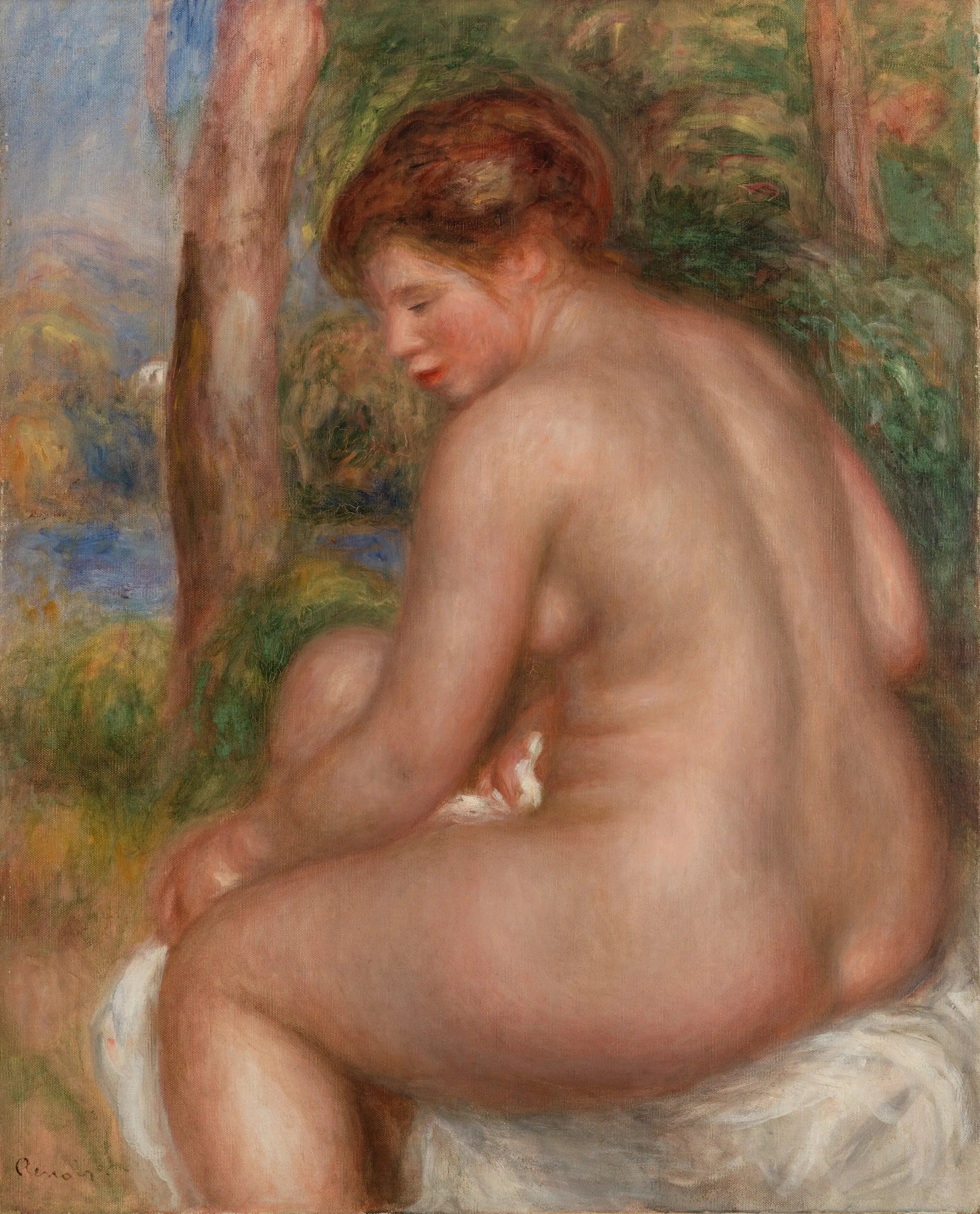
Bather Seen from Three Quarters - Pierre
- Original dimensions
- 66 x 82 cm
- Museum
- Barnes Foundation
- Year
- 1911
Scene depicted
This pictorial work illustrates a bather, posed gracefully, dressed in delicate light. The water reflections dance around her, enveloping the figure in a soothing halo. The painting immortalizes a majestic simplicity, a celebration of femininity in harmony with nature. The soft forms and warm tones transport the viewer into a reality that is both tangible and dreamlike.
Historical context
Created in 1911, this masterful painting finds its roots in Paris, the city of light, then the epicenter of the Impressionist movement. At that time, Renoir passionately explored themes of feminine beauty and light, while being part of a period of great artistic effervescence. Currently, the painting is located at the Barnes Foundation , a sanctuary of Impressionist and Post-Impressionist art.
Place in the artist's career
Bather Seen from Three Quarters is part of a period linked to Renoir's artistic maturity, as he sharpened his style while remaining true to the Impressionist sensibility. When compared to other masterpieces such as "Le Moulin de la Galette" and "La Danse à la Ville," one perceives an evolution in his way of approaching light and movement, reflecting the emotional depth of his career.
Anecdote
“Light is everything,” Renoir declared, thus evoking his perpetual quest to capture the ephemeral essence of each moment. Inspired by a gentle morning on the Seine, he was carried away by the natural beauty of the bathers who brightened the shores. This emotion is embodied in every brushstroke of Bather Seen from Three Quarters, seeming to whisper to viewers the secrets of a stolen moment.