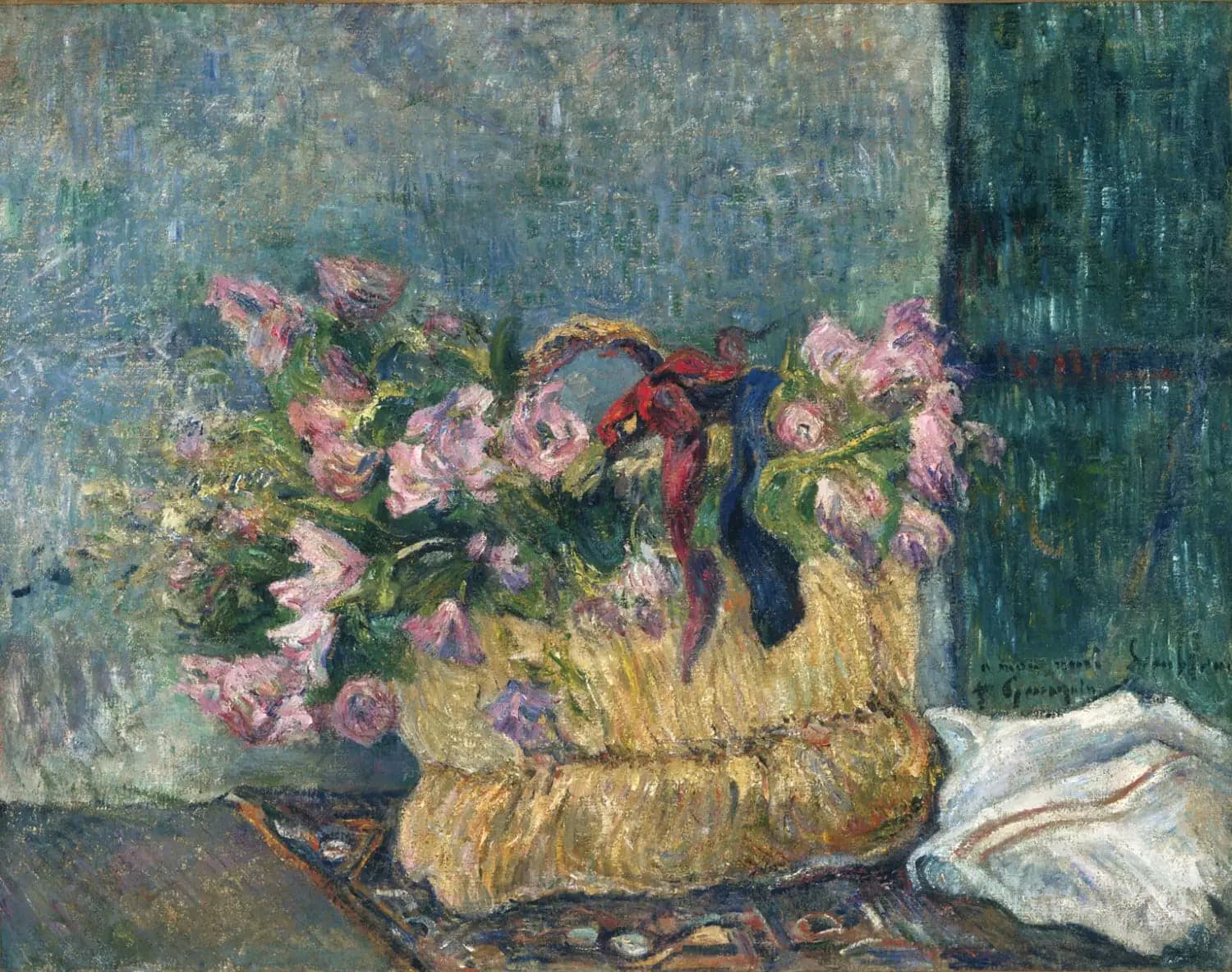
Basket of Flowers, or Flowers in a Basket
- Original dimensions
- 63.2 x 50 cm
- Museum
- Philadelphia Museum of Art
- Year
- 1886
Scene depicted
The canvas “Basket of Flowers, or Flowers in a Basket” reveals a lush composition, where each flower is carefully arranged in a woven basket, a symbol of nature and simplicity. This painting is much more than a simple still life: it is a celebration of everyday life, where each petal seems to whisper secrets of beauty. The light, soft and golden, caresses the floral shapes, highlighting the richness of textures and colors, creating a serene and playful atmosphere.
Historical context
Created in 1886, at the crossroads of Impressionism and Post-Impressionism , this painting emblematic of Paul Gauguin is set in a context where art begins to free itself from strict academic conventions. The canvas , now preserved at the Philadelphia Museum of Art , bears witness to a vibrant light of the period, capturing the very essence of the artistic movement that seeks to evoke emotion rather than mere representation. Its dimensions, 63.2 x 50 cm, are both imposing and delicate, reflecting the pictorial richness it contains.
Place in the artist's career
This canvas marks a turning point in the career of Paul Gauguin , situated between his promising beginnings and his phase of artistic maturity. At this time, he draws closer to his contemporaries while forging a distinctive style, as evidenced by his famous work “The Visionary” and the fascinating “Woman of Tahiti.” The painting of flowers illustrates this evolution, where one perceives a desire for exploration and creative freedom.
Anecdote
“Beauty is but a reflection of the soul,” he might have whispered while painting this masterpiece . Imagine a spring morning in Pont-Aven, where nature bursts with colors. A sweet scent of flowers fills the air, and it is in this tranquility that Gauguin finds his inspiration. This painting then becomes a heartfelt cry, an ode to ephemeral beauty, dear to the artist.