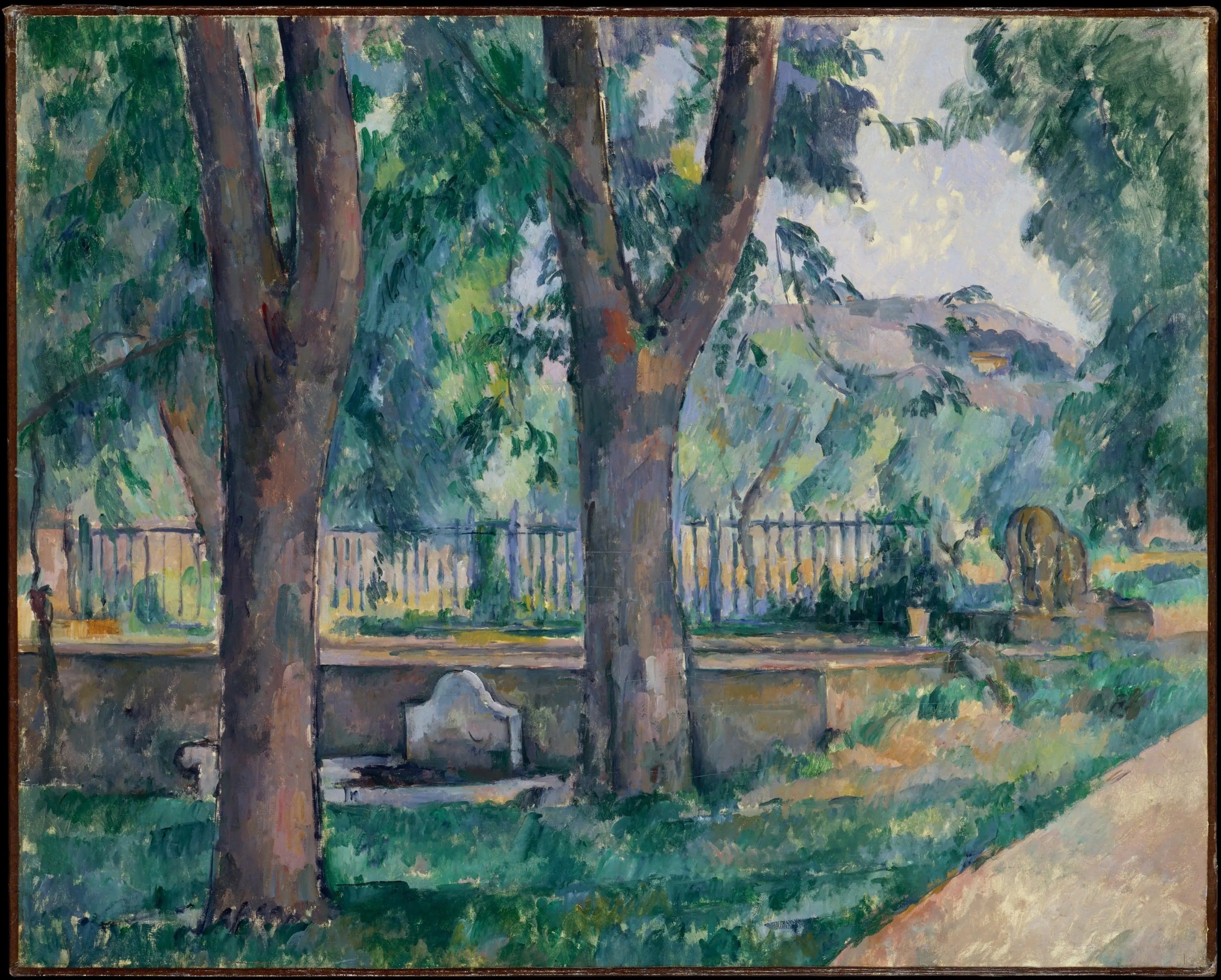
Basin and washhouse of Jas de Bouffan
- Original dimensions
- 81 x 64.8 cm
- Museum
- Metropolitan Museum of Art
- Year
- 1880
Scene depicted
In this canvas , Cézanne evokes a peaceful setting, celebrating the beauty of rural life in the heart of his native Provence. The striking composition transports us to a universe where the basin and the washhouse are not merely elements of the landscape, but witnesses of daily life, bathed in golden light. Each brushstroke, random yet controlled, makes this moment unique, connected to nature.
Historical context
Created in 1880 in Aix-en-Provence, this painting stands out as an emblematic work of the Impressionist movement. Under the sun of Southern France, Paul Cézanne , a major figure in art, captures the very essence of nature and daily life, thus marking a break with the artistic conventions of his time. The canvas is now found at the Metropolitan Museum of Art , where it continues to fascinate art lovers from around the world.
Place in the artist's career
This canvas fits into a pivotal period of Cézanne's work, as he begins to forge his unique style. Alongside other works such as “The Montagne Sainte-Victoire” and “The Card Players,” we perceive the evolution of his technique and his approach to perspective, turning towards bolder and more structured compositions.
Anecdote
“Nature is my only mistress.” This quote from Cézanne resonates with the creation of the masterpiece , born one spring morning by the basin. The murmur of the waters and the sounds of birds in the background nourish the artist's inspiration, whose gaze lingers on the reflections and lights dancing on the surface of the canvas.