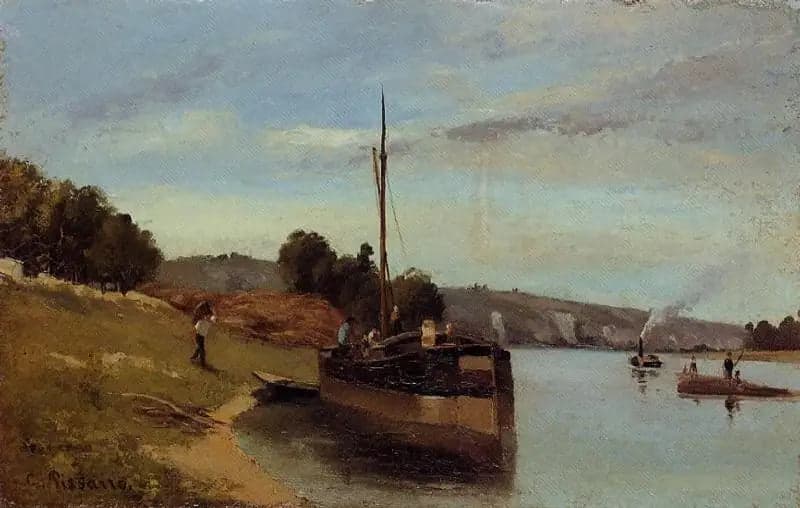
Barges at La Roche-Guyon Argenteuil, Fairground
- Original dimensions
- 72 x 46 cm
- Museum
- Pissarro-Pontoise Art and History Museum
- Year
- 1863
Scene depicted
The painting depicts a lively scene where barges glide slowly over the shimmering waters of the Seine, while the cheerful tumult of a funfair invites itself in the background. The vibrant colors harmonize with the delicacy of nature's movements, while the joyful cries of children mingle with the sweet smell of cotton candy. Each element of the composition invites the viewer to dive into an innocent happiness, forever frozen in this vibrant pictorial work.
Historical context
Created in 1863, this iconic work finds its roots in Argenteuil, a charming corner of France, representing the cheeky elegance of the Impressionist movement that was emerging at the time. At the heart of the artistic effervescence of the Seine, this painting reveals a world where light dances on the water and where the barges, emblematic figures, mingle with the joyful laughter of a funfair. Today, the painting is preserved in the Pissarro-Pontoise Art and History Museum, thus preserving for eternity the essence of the moment captured in this canvas.
Place in the artist's career
Barges at La Roche-Guyon Argenteuil is part of a fervent period for the artist, illustrating his exploration of themes of modern life. This painting, as much as The Garden of the Cure, and Boulevard de l'Opéra, bears witness to his constantly evolving style, oscillating between emerging pointillism and a calming realism . By beginning to capture the details of his immediate environment, Pissarro lays the foundations of his Impressionist approach, marking this painting as a major milestone in his artistic journey.
Anecdote
“Beauty lies in the ephemeral,” Pissarro declared one August morning as he stood on the banks of the Seine. It was there, under the gentle breath of the spring wind and surrounded by golden colors, that he grasped the magic of the play of shadow and light. This revelation inspired the creation of Barges at La Roche-Guyon Argenteuil, making this canvas a masterpiece filled with meaning and emotion.